<?xml version="1.0" encoding="utf-8"?><feed xmlns="http://www.w3.org/2005/Atom" ><generator uri="https://jekyllrb.com/" version="4.4.1">Jekyll</generator><link href="https://blog.jpwalling.com/feed.xml" rel="self" type="application/atom+xml" /><link href="https://blog.jpwalling.com/" rel="alternate" type="text/html" /><updated>2025-08-18T05:47:22+00:00</updated><id>https://blog.jpwalling.com/feed.xml</id><title type="html">Jesse’s Window</title><subtitle>Presenting insights into my current passions - including but not limited to software development, cyber security, system administration, cryptocurrency, and art.</subtitle><entry><title type="html">Moonshots, Malice, and Mitigations</title><link href="https://blog.jpwalling.com/superintelligence/agi/ethics/whateverism/2024/06/26/moonshots-malice-and-mitigations.html" rel="alternate" type="text/html" title="Moonshots, Malice, and Mitigations" /><published>2024-06-26T00:00:00+00:00</published><updated>2024-06-26T00:00:00+00:00</updated><id>https://blog.jpwalling.com/superintelligence/agi/ethics/whateverism/2024/06/26/moonshots-malice-and-mitigations</id><content type="html" xml:base="https://blog.jpwalling.com/superintelligence/agi/ethics/whateverism/2024/06/26/moonshots-malice-and-mitigations.html"><![CDATA[<p><img src="/assets/3m/1-robot.png" alt="A happy robot, shielded from the pouring rain" /></p>

<p>The world around us is moving fast, and there aren’t any signs of it slowing down anytime soon. OpenAI, one of the most widely known AI (Artificial Intelligence) research corporations was founded in 2015 (<a href="https://www.crunchbase.com/organization/openai">Crunchbase</a>). Back then, the technology that underpins ChatGPT hadn’t been discovered yet. These ‘Transformer’ AI models were first created in 2017 (<a href="https://arxiv.org/abs/1706.03762">arXiv</a>). Unbeknownst to most, OpenAI leaned heavily into Transformer models. Their efforts started a global AI arms race with the grandiose release of DALL-E (2021, <a href="https://en.wikipedia.org/wiki/DALL-E">Wikipedia</a>), ChatGPT (2022, <a href="https://en.wikipedia.org/wiki/ChatGPT">Wikipedia</a>), GPT-4 (2023, <a href="https://en.wikipedia.org/wiki/GPT-4">Wikipedia</a>), Sora (2024 demo, <a href="https://en.wikipedia.org/wiki/Sora">Wikipedia</a>), and GPT-4o (2024, <a href="https://en.wikipedia.org/wiki/GPT-4o">Wikipedia</a>). In this blog post, we seek to answer the question: How do we navigate a rapidly changing future with advanced AI models?</p>

<p>Note: Please watch at least the first demo page / video linked below before continuing. Additional videos provide some helpful context as well.</p>
<ul>
  <li>OpenAI Sora Demo (<a href="https://openai.com/sora">OpenAI</a>)</li>
  <li>AI Explained Sora Video (<a href="https://youtu.be/nYTRFKGR9wQ?si=pxVzm143L0Nd7kbe">YouTube</a>)</li>
  <li>MKBHD Sora Video (<a href="https://youtu.be/NXpdyAWLDas?si=3R5hMFF1nLHDKYsN">YouTube</a>)</li>
</ul>

<p>Keep in mind that the views in this blog post are highly subjective and up for debate or alternative interpretation. This blog post does discuss financial assets and economics, but these topics should <em>NOT</em> be considered investment advice or any sort of official guidance. Please do your own research and talk to a financial advisor if needed - it is possible that you will reach different conclusions than the author of this post.</p>

<p>Before getting ahead of ourselves, let’s review some quick background on how GPT models work.</p>

<h1 id="gpt-models">GPT Models</h1>

<p><img src="/assets/3m/2-bigscale.png" alt="Large overview of a GPT model, with ideas and data flowing from humans to the machine in a perpetual cycle" /></p>

<p><em>(TIP: Right click on an image and open it in a new tab to see a higher-resolution version)</em></p>

<p><strong>Generative</strong> - Outputs text or other media on the fly<br />
<strong>Pre-Trained</strong> - Already trained on a large amount of data<br />
<strong>Transformer</strong> - An AI model to convert symbols or fill in the blanks accurately</p>

<p>GPT models are a type of AI model that creates <em>new</em> content. This model went through a period of training, where it was fed text at a colossal scale. This isn’t a factual statement, yet it is within reason to say that OpenAI’s GPT-4 was trained on most sequences of words available on the internet - Wikipedia, most books, research papers, transcriptions, forum interactions, technical documentation or articles, and more… But, how exactly does it understand your input? Additionally, how does it understand the output? Well, it doesn’t. Instead, it both interprets and generates <em>patterns</em>.</p>

<p>Take a moment to think about the following sentence and try to fill in the blank: “At the next intersection, take a ___.” There’s a pretty high likelihood you may have thought ‘left’ or ‘right’ in that example. Why is that? Primarily because of the order that words were written, and the context of those words individually. In Transformer models, every word in existence is represented numerically in a table. Not only are the words themselves numerically represented, but also the relative structure of them - based on the training data from earlier. The YouTube channel 3blue1brown recently created a great video series explaining Transformer models (3blue1brown <a href="https://youtu.be/wjZofJX0v4M?si=Om0r8HoShd-RPN11">YouTube</a>)</p>

<p>GPT models leverage their large corpus of text training in matrices as model weights, which words to ‘focus’ on over others (attention), and ordering of the words (positionality) - to both interpret your input <em>and</em> generate output.</p>

<p>If you are curious about how Transformers work at a very granular level, please read ‘Transformers From Scratch’ (at <a href="https://e2eml.school/transformers.html">e2ml school</a>) by Brandon Rohrer. They seem to enjoy linear algebra more than the author of this post.</p>

<h2 id="emergent-capabilities">Emergent Capabilities</h2>

<p>At a massive scale, GPT models present abilities that were not included in their training data. These are called emergent capabilities. One of the most prevalent examples of this is that early versions of GPT-4 could create images through SVG vector software, without having prior examples in its’ training data (Sparks of Artificial General Intelligence, Page 16 <a href="https://arxiv.org/abs/2303.12712">arXiv</a>).</p>

<blockquote>
  <p>“Given that this version of the model is non-multimodal, one may further argue that there is no reason to expect that it would understand visual concepts, let alone that it would be able to create, parse and manipulate images. Yet, the model appears to have a genuine ability for visual tasks, rather than just copying code from similar examples in the training data.”</p>
</blockquote>

<p>This is important because we, as humans, did not provide or instruct GPT-4 the training data that would explain its’ ability to receive input and generate output at that caliber. Recently, a text-to-speech (TTS) AI model at Amazon showed emergent capabilities in pronouncing uniquely complex sentences that weren’t included in the training data either (2024, <a href="https://techcrunch.com/2024/02/14/largest-text-to-speech-ai-model-yet-shows-emergent-abilities/">TechCrunch</a>). Additionally, OpenAI themselves referenced emergent capabilities of Sora, where they provided additional compute and, poof!… The videos got immensely more realistic (2024, <a href="https://openai.com/research/video-generation-models-as-world-simulators?trk=article-ssr-frontend-pulse_little-text-block">OpenAI</a>).</p>

<blockquote>
  <p>“In this work, we find that diffusion transformers scale effectively as video models as well. Below, we show a comparison of video samples with fixed seeds and inputs as training progresses. Sample quality improves markedly as training compute increases.”</p>
</blockquote>

<p>Not only that, but it seemed to have inherent simulation capabilities regarding physics, but it’s hypothesized that this was at least partially included in the training data using the game development platform ‘Unreal Engine 5’ (Jim Fan, Head AI Researcher at Nvidia <a href="https://twitter.com/DrJimFan/status/1758210245799920123">Twitter / X</a>)</p>

<h2 id="alignment">Alignment</h2>

<p>It’s worth focusing on the term ‘alignment’ before moving too far ahead as well. Recall that training data is dumped into the GPT model en masse - more training data generally results in better performance of the model in terms of nuance and depth of outputs (read: chatbot responses). These training data sources typically include opinionated pieces of writing and subjective topics from Reddit, other blog posts, or forum posts and more. Since the training data is used as a point of reference for GPT models, highly opinionated input leads to highly opinionated output. This is the exact reason why many open source AI models will say they are human, despite being computer software - they were trained on existing data that <em>already discussed</em> what it means and is like to be human. When dealing with harmful information to society at large, the colloquial term for this is ‘garbage in, garbage out’ (2023, <a href="https://www.nature.com/articles/d41586-023-03316-8">Nature</a>).</p>

<p><img src="/assets/3m/3-misalignment-v2.png" alt="Chart with increasingly concerning misalignments of an AI, ranging from 'emergent ability to prefer certain chat behaviors' to 'human seek and destroy for entertainment'" /></p>

<p>Alignment is the practice of ensuring that the output from AI models like GPT-4 align with human values (in avoidance of the above illustration). This is achieved by three (3) currently utilized strategies, among a couple not listed:</p>
<ol>
  <li>RLHF (Reinforcement Learning from Human Feedback) (<a href="https://en.wikipedia.org/wiki/Reinforcement_learning_from_human_feedback">Wikipedia</a>)</li>
  <li>Guardrails (Separate software implementations that detect off-limits topics and halt interaction) (<a href="https://opendatascience.com/how-to-use-guardrails-to-design-safe-and-trustworthy-ai/">Open Data Science</a>)</li>
  <li>RLAIF (Reinforcement Learning from Artificial Intelligence Feedback) (<a href="https://towardsdatascience.com/rlaif-reinforcement-learning-from-ai-feedback-d7dbdae8f093">Towards Data Science</a>)</li>
</ol>

<p>There are additional strategies for alignment with more powerful AI, but they will not be discussed in this blog post. <em>Superintelligence</em> by Nick Bostrom discusses some of these topics more in-depth if you are curious.</p>

<p>RLHF has been used extensively in the past, across other AI technologies. Fundamentally, it is the process of presenting the output of an AI model to a human that provides feedback on whether or not the output was ‘good’ or ‘bad’. This feedback is provided back to the model, and continues to use it as reference for its’ own outputs. RLAIF is a similar idea, but leverages existing less-powerful GPT models instead of humans to evaluate the output of other more-powerful models. In the author’s opinion, RLAIF should be used sparingly and with caution.</p>

<p>Why be cautious? Mainly because misalignment, paired with emergent abilities, could be a dangerous combination. If there are emergent abilities that we notice, it’s likely that there are emergent capabilities that we don’t - especially once the model showcases general capabilities that exceed humans.</p>

<h1 id="moonshots">Moonshots</h1>

<p>We are rapidly approaching a turning point where the capabilities of these newfound AI models achieve human-level parity on cognitive and reasoning abilities. This 1:1 parity is considered AGI (Artificial General Intelligence). Once these AI models <em>surpass</em> human parity, it would be considered ASI (Artificial Super Intelligence) - referred to as ‘Superintelligence’ in this post.</p>

<p>As mentioned before, many foundational concepts of ‘Superintelligence’ are discussed in Nick Bostrom’s 2014 work of the same name.</p>

<p>As with most tools, there are proper, productive, or beneficial ways to utilize them, while juxtaposed by negative outcomes and unexpected uses - whether intentional or not. In this blog post, we hypothesize that AI (Transformer models in particular) will <em>fundamentally alter</em> how society operates in the next 20 years.</p>

<p>Below, we provide moonshots on the left, and associated pitfalls on the right:</p>

<table>
  <thead>
    <tr>
      <th>Moonshots</th>
      <th>Pitfalls</th>
    </tr>
  </thead>
  <tbody>
    <tr>
      <td><em>Abundance of:</em><br />- Scientific discoveries<br />- Technological advancements<br />- Rapid iterations</td>
      <td><em>Destruction of:</em><br />- Individual identity<br />- Security<br />- Privacy</td>
    </tr>
    <tr>
      <td><em>Opportunity for:</em><br />- Public access<br />- Essential services<br />- Liesure</td>
      <td><em>Gatekeeping through:</em><br />- Policies<br />- Surveillance<br />- Mandates</td>
    </tr>
    <tr>
      <td><em>Education via:</em><br />- Ease of use<br />- Ease of understanding<br />- Self-guided exploration</td>
      <td><em>Idiocracy via:</em><br />- Over-reliance<br />- Stasis<br />- Blind trust</td>
    </tr>
    <tr>
      <td><em>Techno-Capitalism via:</em><br />- Deflationary pressure<br />- Negligible margins<br />- Autonomous corporations</td>
      <td><em>Pseudo-Communism via:</em><br />- Universal Basic Income<br />- Technological centralization<br />- Government capture<br />- Price fixing</td>
    </tr>
    <tr>
      <td><em>Enthusiasm for:</em><br />- Brain-computer interfaces<br />- World simulations<br />- Digital Saccharine Sensations</td>
      <td><em>AI-age Luddites, embracing:</em><br />- Sneaker nets<br />- Analog communications<br />- In-person communities<br />- Sensemaking</td>
    </tr>
    <tr>
      <td><em>Decreased class divide by:</em><br />- Personalized advising<br />- Intervention<br />- Lower costs from deflation</td>
      <td><em>Dramatic class divide by:</em><br />- Technological comfort<br />- Currency manipulation<br />- Bias</td>
    </tr>
    <tr>
      <td><em>Peace via:</em><br />- Impartial negotiations<br />- Mutual understanding<br />- Collaboration</td>
      <td><em>Conflict via:</em><br />- Disinformation<br />- Techno/Bio/Nano terrorism<br />- Technological nationalization</td>
    </tr>
    <tr>
      <td><em>Digital self through:</em><br />- Augmented high-fidelity self rendering<br />- Memory backup and recall</td>
      <td><em>Digital Likeness Theft for:</em><br />- Extortion<br />- Blackmail</td>
    </tr>
  </tbody>
</table>

<p>We assume the following in this hypothetical future:</p>
<ol>
  <li>Superintelligence has been achieved. One or multiple platforms provide capabilities far beyond humans in terms of language, science, math, research, audio, video, game development, real-time world simulations, reasoning, planning, and manipulation of the physical world through fleets of humanoid (or other form factor) robots.</li>
  <li>The Superintelligence may or may not have ulterior motives, likely revealing them at a later date; this all depends on what OpenAI and other companies like Microsoft, Anthropic, Mistral, Google, Amazon, and Meta take into account regarding alignment and emergent capabilities today onwards.</li>
  <li>Ideally, the Superintelligence would have enough reach and working capabilities to address all pitfalls listed above, but this isn’t a guarantee due to competing platforms, decentralized Superintelligence implementations, or human greed.</li>
</ol>

<h1 id="more-background">More Background</h1>

<h2 id="current-ideologies-on-ai-development">Current Ideologies on AI Development</h2>

<p>There exist three primary ideologies surrounding AI today:</p>

<ul>
  <li>Accelerationism (a/acc)</li>
  <li>Effective Accelerationism (e/acc)</li>
  <li>Doomerism / Decelerationism (d/acc)</li>
</ul>

<p>Accelerationists present the argument that all innovation in AI is good innovation and that research should continue to accelerate. Doomerists are the opposite, arguing that pushing through development of AI is foolish and has a high likelihood of ending in disaster. There are some ideologies in the middle of the road, like Effective Accelerationism, where the end goal is to continue innovating, but realize that there are considerations throughout the process that should not be swept under the rug.</p>

<p>Let’s take the Sora demos from OpenAI as an example. Accelerationists would applaud the innovation, yet be frustrated with OpenAI since it hasn’t been released to the public at the time of writing. They would scoff at OpenAI’s requirement of a red team to try and test edge cases that would result in offensive, defamatory, or otherwise unsavory videos. Effective Accelerationists would also applaud the innovation, but happily wait for OpenAI’s red team to finish internal testing. Decelerationists would likely argue that the evidence of emergent capabilities are a red flag and that development should stop in entirety. Effectively, there are multiple different camps that people in the field fall into regarding AI research and advancement. The author of this post is an Effective Accelerationist, but makes the argument for a new, more realistic ideology.</p>

<h2 id="introducing-wacc-whatever-accelerationism">Introducing w/acc (Whatever Accelerationism)</h2>

<p><img src="/assets/3m/4-aicompass.png" alt="Political compass of AI methodologies" /></p>

<p>Whatever Accelerationism, abbreviated as w/acc and pronounced as ‘wack’, is the idea that market forces will likely default to Accelerationism or Effective Accelerationism. These market forces are largely outside of control from individuals, so it appears borderline pointless to quibble about whether we should kick everything into high gear or slam on the brakes. The beauty of w/acc is that it doesn’t require any large company, government, or other institution to pick a lane for the good of humanity. On the whole, w/acc facilitates an open and understanding perspective of AI, with varying degrees of comfort from person to person - no matter what the tech behemoths do.</p>

<p>A brief aside on the ‘market forces’ mentioned here. They come from a few combinations of beliefs, starting with the idea that under capitalism, costs fall to the marginal cost of production. So, as production costs decrease, overall costs decrease, which is deflationary under extreme innovation. Another idea is the ‘invisible hand’ that Adam Smith describes in markets; tapping, moving, aligning financial data as a collective understanding, yet decentralized force (<a href="https://www.investopedia.com/terms/i/invisiblehand.asp">Investopedia</a>).</p>

<p>It’s been discussed online that the best way to fight against this market-driven centralization is by utilizing open source AI models (Peter Diamandis, Emad Mostaque <a href="https://youtu.be/e1UgzSTicuY?si=7kmz1tEnzvGNNYo9">YouTube</a>). Overall, this is a reasonable and optimistic take. If we decentralize the usage of AI, we reduce the risk of myopic corporate greed and increase the likelihood of achieving moonshots. That being said, none of the pitfalls listed earlier automatically disappear with decentralization.</p>

<p>What matters the most for Whatever Accelerationism is safely utilizing modern AI technologies to the extent that an individual is comfortable while considering risks and other externalities as needed. Keep in mind, this is similar in concept to risk vs. reward tolerance when investing or trading (<a href="https://www.investopedia.com/terms/r/riskrewardratio.asp">Investopedia</a>). Some people may avoid certain aspects while others will keep just one consideration as their primary focus - and that’s OK. For AI technologies in the present and future, this materializes as a tradeoff between productivity and risk. As an example, let’s say your w/acc operating principle is that centralized AI should be avoided due to potential misalignment of models. You would end up using only locally-run GPT models, successfully ensuring privacy from corporations, yet sacrificing features and custom-built applications.</p>

<p>Thinking on a perpetual basis and considering market forces are crucial as well. We said it at the start - ‘the world around us is moving fast, and there aren’t any signs of it slowing down anytime soon’. Market forces keep innovation moving forward.</p>

<p>Part of understanding a technology over time includes noting and evaluating its shortcomings. Staying on top of AI developments and utilizing them at your own pace is crucial to forming a mental model. This mental model will help you, whether completely aware of it or not - evaluate the benefits, considerations, and risks of significant technological advancements when they occur. This blog post is a great first step, but isn’t a definitive reference - search engines like DuckDuckGo (<a href="https://duckduckgo.com">Search with DDG</a>) remain incredibly powerful tools.</p>

<h1 id="malice-or-negligence">Malice (or Negligence)</h1>

<h2 id="superintelligence-testing">Superintelligence Testing</h2>

<p><img src="/assets/3m/5-paddedcomputer.png" alt="A CRT computer monitor sits in the middle of a padded room" /></p>

<p>There are currently several small to massive corporations developing GPT models with the eventual goal of reaching AGI and Superintelligence. Unfortunately, there isn’t much transparency regarding corporate development processes and ongoing projects. Some companies are better than others, but fully open practices are rare. Below, we outline some relatively intuitive security practices that these companies should be following.</p>

<p>At the time of writing, the clear leader in AI safety is Anthropic. They are frequently transparent with the public about their practices and research on flagship AI models like Claude 3. On the opposite end of the spectrum we have Google and OpenAI, both with their own respective troubles in safety. Google had a significant blunder recently, where their ‘AI Summary’ functionality was providing users with incorrect and sometimes harmful behavior (2024, <a href="https://www.theverge.com/2024/5/24/24164119/google-ai-overview-mistakes-search-race-openai">The Verge</a>). Also, OpenAI’s team focusing on Superintelligence safety was recently dissolved, resulting in some drama we will revisit later (2024, <a href="https://pureai.com/Articles/2024/05/20/OpenAI-Superintelligence-Safety-Disbanded.aspx">Pure AI</a>).</p>

<h3 id="network-segmentation-and-airgaps">Network Segmentation and Airgaps</h3>

<p>Proper network segmentation and, as a gold star bonus - airgapped development environments - are crucial to proper network security in any environment. Network segmentation is the process of ensuring that computers are <em>ony</em> allowed to talk to the other computers that they <em>need</em> to. For example, it would not be proper network segmentation to allow critical infrastructure that maintains operation of a nuclear power plant any connection outside of the control room. Maybe it would occasionally download software updates, but that should be done strategically and when necessary. Additionally, there are ways to update software without a path to WAN (Wide-Area Network, read: publicly available internet) or stay on (V)LAN (read: [Virtual] Local Area Network). Airgapped computers take this a step further, where they are completely disconnected from local or wide-area networks - they operate on their own, with physical access being the only way to interact with them.</p>

<p><img src="/assets/3m/6-airgap.png" alt="A comparison between network segmentation and air gap" /></p>

<p>While testing AGI or Superintelligence, there is no fundamental reason for these GPT models to have a route to the open web either. It would be concerning if an emergent capability were network traversal and communication back to the model itself as a command and control center (C2) to automatically enable distributed AI agents across networks. Interestingly enough, this is a primary behavior of the hypothetical ‘Morris II’ worm recently created by researchers (2024, <a href="https://www.wired.com/story/here-come-the-ai-worms/">Wired</a>, <a href="https://arxiv.org/abs/2403.02817">arXiv</a>).</p>

<h3 id="perpetual-monitoring">Perpetual Monitoring</h3>

<p>Perpetual monitoring of these GPT models is also important. It is currently very difficult to ‘see’ how the GPT models curate a specific output based on a given input. We don’t know fully how it generates specific outputs. For one specific input, outputs are rarely exactly the same. Monitoring of these models is a difficult engineering challenge, but one that should be pursued - if not to monitor the model, then to better understand its’ inner workings.</p>

<p>Anthropic’s recent research paper, ‘Scaling Monosemanticity: Extracting Interpretable Features from Claude 3 Sonnet’ shows some very promising early research regarding how these models could be monitored and better understood (2024, <a href="https://transformer-circuits.pub/2024/scaling-monosemanticity/index.html">Anthropic</a>). Their findings provide previously unknown details of how specific neurons in layers of the neural network handle different contexts, paving the way to proper monitoring of models more capable than humans.</p>

<h3 id="physical-security">Physical Security</h3>

<p><img src="/assets/3m/7-supertesting.png" alt="An ideal Superintelligence testing floor, with the Superintelligence hardware viewable by everyone, but only through one-way windows" /></p>

<p>All systems part of the GPT model should be at the same physical location while testing and follow strict Role Based Access Control (RBAC) models, with access to the model only allowed in-person. There are three parties involved here: the tester or developer, the monitoring team, and the Superintelligence. The Superintelligence would not be able to connect outside of the floor or building in any way. The Superintelligence would be running on servers in their own room, with one-way glass walls on two sides. Next to this room, on one side, would be the developer area. Again, two sides being glass. The third room is for the monitors and spans between developers and the Superintelligence. Many might view this strategy as excessive, or too cautious - yet, the risk is far too high to be any sort of naive when it comes to Superintelligence.</p>

<p>It is probable that many of the existing players are following proper network segmentation practices as originally hoped. It is unlikely that they have the degree of physical security needed to safely develop AI models with capabilities exceeding humans. Their test environments are probably run on Azure (Microsoft) or AWS (Amazon) infrastructure. While this isn’t malice, the author of this post does believe that it is negligence.</p>

<h2 id="secretive-culty-superintelligence">Secretive Culty Superintelligence</h2>

<p><img src="/assets/3m/8-culty.png" alt="An office worker, mesmerized by the Superintelligence levitating above their desk" /></p>

<p>We start this section by revisiting Sam Altman’s firing from OpenAI in November 2023. The details of these events were peculiar, with several prevalent theories:</p>
<ul>
  <li>Hostile takeover</li>
  <li>Conflict of interest (Sam Altman runs many other AI-related startups)</li>
  <li>Negligence from Sam Altman (possibly failing to disclose details or a discovery to the board)
    <ul>
      <li>Q* (AI model highly capable at math, unlike ChatGPT or GPT-4) (AI Explained <a href="https://youtu.be/ARf0WyFau0A?si=vdIRtCFR8Hf-KN-I">YouTube</a>)</li>
      <li>Early versions of Sora</li>
      <li>An undisclosed AGI or Superintelligence breakthrough</li>
    </ul>
  </li>
</ul>

<p>There was never a concrete conclusion to these events, aside from the fact that the employees of OpenAI ultimately petitioned to bring him back - just over 87% of them, foregoing work and tasks at hand until Sam came back to the company. At one point, Microsoft was going to spin up an entirely new department with Sam Altman and any employees that wanted to follow him to the tech behemoth. These efforts were promptly cancelled and operations resumed when Sam Altman returned to OpenAI just a few days after being forced out (2023, <a href="https://time.com/6338789/sam-altman-openai-return-timeline/">Time</a>).</p>

<p>In the 2024 edition of these dramatic events, two of their top AI safety engineers quit, with one of them posting on X ‘safety culture and processes have taken a backseat to shiny products’ (2024, <a href="https://x.com/janleike/status/1791498184671605209">@janleike X / Twitter</a>). With OpenAI recently releasing the best performing multimodal (text, voice, image) GPT model, GPT-4o, these staff changes are somewhat concerning.</p>

<p>The other high-profile employee that recently resigned, Ilya Sutskever, used to reportedly chant ‘FEEL THE AGI!’ with employees to spur a sense of community and purpose at OpenAI. But, was it more than just that? (2023, <a href="https://futurism.com/openai-employees-say-firms-chief-scientist-has-been-making-strange-spiritual-claims">Futurism</a>). Could Sam Altman have been removed from OpenAI because of Sora? Or the recently released GPT-4o? Or a more advanced AI model or product? Possibly, but let’s look at the facts.</p>
<ol>
  <li>Sam Altman was temporarily ousted from his own company</li>
  <li>The largest tech giant (Microsoft) backed him up with capital and resources promised, for all existing employees and Sam</li>
  <li>They release demos for Sora</li>
  <li>They release GPT-4o and are once again are the most performant GPT model creator (Until Anthropic’s Claude Sonnet 3.5)</li>
  <li>Moments later, at least two engineers focused on Superintelligence alignment leave the company</li>
</ol>

<p>The next section is sure to calm your nerves…</p>

<p>Regardless of the next section, it seems unlikely that secrecy of big advancements would be localized to OpenAI. Google, Amazon, and Meta could logically be doing the same. This then spurs the question, why wouldn’t these companies keep a Superintelligence private until they encounter worthy competition? After all, it would best be used internally to increase shareholder value, at least at first. OpenAI will have more dirty laundry in the news, alongside other companies when discoveries are made. This is when we enter the idea of a secretive Superintelligence, where company culture and subsequent drama surround opaque technological advancements.</p>

<p>Here’s the bottom line: an ultra-secretive arms race is in the bottom of the fifth inning. If these tech powerhouses are competing to reach AGI and Superintelligence, they will get there one way or another for better or worse. It comes down to who releases first, and more importantly - if they did it right.</p>

<h2 id="openais-recent-policy-change-on-military-involvement">OpenAI’s Recent Policy Change on Military Involvement</h2>

<p><img src="/assets/3m/9-militaryai-generic.png" alt="A military Hummer drives through the desert, brandishing a familiar yet partially redacted flag" /></p>

<p>Continuing on with the thought of an AGI or Superintelligence breakthrough at OpenAI, these next developments are particularly interesting. For several years, OpenAI has had a known stance against involvement with the military or U.S. Government, outside of regulation discussions. This recently changed. OpenAI quietly removed their own guideline surrounding military involvement and announced a collaboration with DARPA on ‘cybersecurity tools’ (2024, <a href="https://techcrunch.com/2024/01/12/openai-changes-policy-to-allow-military-applications/">TechCrunch</a>). While this vague project is very intriguing, we’ll lean to speculation until there are more details or a product release of some sort.</p>

<p>OpenAI is now meeting with the government. In the author’s opinion, this is a significant red flag. It’s one thing to work with the military, but it is another thing to pull a total u-turn in moral compass. Could it be that OpenAI was forced to do so after disclosing Q* or another technological advancement to the government during Sam Altman’s ousting in November 2023? Their policy change occurred <em>after</em> Sam Altman’s ousting was attempted, after all. It’s possible that this is the first indication of government capture, forcing OpenAI to disclose technologies and open their doors to the U.S. government. Further backing up this argument is the recent news that OpenAI appointed a former ‘commander of U.S. Cyber Command and the director of the National Security Agency’ to their board of directors (2024, <a href="https://apnews.com/article/openai-nsa-director-paul-nakasone-cyber-command-6ef612a3a0fcaef05480bbd1ebbd79b1">AP News</a>). Admittedly, this appears to be a strategic move from OpenAI to address the ever-present risk of cyber attacks from nation states, insider threats, supply chain attacks, and more.</p>

<p>The military has historically been a hub for technological exploration and innovation - you wouldn’t be able to read this blog post without the foundational work they did on ARPANET (<a href="https://en.wikipedia.org/wiki/ARPANET">Wikipedia</a>). Wouldn’t DARPA and the Department of Defense be interested in utilizing OpenAI’s next-generation model rather than what is publicly accessible to the world with GPT-3.5, GPT-4, and GPT-4o? They already do this for startups under OpenAI’s venture capital wing after all (This Week In Startups <a href="https://youtu.be/bFS1KCuaMJ4?si=VEbaZsaq0HwnTZgh&amp;t=2539">YouTube</a>). Why wouldn’t OpenAI do the same for use cases that the government is interested in? Going further, the guardrails could still be under development or even intentionally removed for their extra special government client. How would the U.S. government realistically utilize this? To propagate democracy (read: domestic and international assertion of power) through media (read: propaganda created with assistance from OpenAI’s GPT models) and strategic interventionism (read: advancement of the Military AI Industrial Complex).</p>

<h1 id="mitigations-in-order-of-importance">Mitigations (In Order of Importance)</h1>

<h2 id="appreciation-of-existence">Appreciation of Existence</h2>

<p>Generally speaking, being present in the moment is worthwhile advice. As we grow older, the passage of time and scale shifts significantly. Unfortunately, it is easy to take things for granted over time. In both the current world, and a potential future world with Superintelligence, being present in the moment is crucial to being human and living a rewarding life. Being human and knowing how to acknowledge that is one of the best parts about living in the moment. Whether through spontaneous disaster, hidden motives, gradual erosion, or technical advancement - our own definition of what it means to be human will become extremely subjective. Make the most of it while you can.</p>

<p>With the release of Sora, there are more questions than answers for most people. More fear than optimism. More concern than intrigue. While this isn’t a bad thing and everyone should have their own opinions about it, this juxtaposition underscores <em>why</em> it is important to live in the moment. Do me a favor - take at least 60 seconds to look away from this blog post - look around, stand up, interact with your environment - but try not to think too hard.</p>

<p>…</p>

<p>What did you notice? Was it the crack in window moulding that you hadn’t seen before? Was it the way that the clouds moved across the sky, or trees flowing in the wind? Was it the the drip of a faucet? A fast car driving by? Regardless of your answer, living in the moment means taking the world in, right now, with admiration. Living in the moment means finding beauty in minute things or occurrences, even if you are waiting in line at the DMV.</p>

<p>There is nuance to <em>everything</em>. The world that we live in is bizarre, yet calculated. Unpredictable, yet largely immutable. Tangible, yet abstract.</p>

<p>We can quibble all we want about whether or not Sora is beneficial to society and what implications there are in the long term. Fact of the matter is - we exist in a time where we know what it means to be human, for this specific instant. That could change very quickly as we march into the future.</p>

<h2 id="security-words-in-irl-relationships">Security Words in IRL Relationships</h2>

<p>Security Words are commonly used in secure, high-clearance environments as a way to confirm that there was a prior discussion surrounding access and responsibility. The words themselves, agreed upon between two people or entities (no more and no less), can be viewed as a sort of contract. This contract answers one question very easily: Are you who you say you are?</p>

<p>This question will be asked more often over time, regardless of any security clearance or specific setting. If you don’t have a tangible way to answer the question of whether or not someone is who they say they are, then the question is impossible to answer. This is a question you will <em>need</em> to be able to answer. Establishing security words for life, rather than work or governmental access, is crucial to survival in the 21st century. Starting this process with individuals important to you - a parent, partner, friend, or even frequent acquaintances - are all perfect examples of who to establish security words with.</p>

<p>These security words should be agreed upon in-person, face-to-face with the other individual. It is reasonable, albeit less secure in the long term, to establish these words over the phone and confirm in-person at a later date. In addition to in-person relationships, security words should be embraced by teams that work closely together, especially those more in the public eye for extortion or fraud - like a celebrity and their publicity team, members of a C-Suite, or politicians and existing members of government for example. Malicious actors are already leveraging voice models to impersonate CEOs (2024, <a href="https://futurism.com/the-byte/hackers-cloned-lastpass-ceo-voice">Futurism</a>). Ideally, these security words should be memorized. If there are too many words for you to keep track of, write them down on paper or stamp them in titanium (<a href="https://www.stampseed.com/shop.html">StampSeed</a>) and store in a secure location.</p>

<p><img src="/assets/3m/10-securitywords.png" alt="An example of a simple list of security words" /></p>

<p>Why paper or titanium? An extra measure of security, essentially. In the event that a Superintelligence were to gain access to a computer or network of computers without prior notice or approval, nothing is safe. It is the same concept as a Bitcoin wallet - the 12 or 24 words used to represent your private key are at risk of being stolen with a software ‘hot’ wallet if compromised by malware or cryptojacking software. For this reason, having no record of your security words in the digital realm is encouraged.</p>

<h2 id="general-purpose-preparations">General-Purpose Preparations</h2>

<p>The preparations in this section are not directly related to AI, but moreso the ideology of ‘prepping’. This is effectively the idea that doom could present itself at any time, unexpectedly and instantaneously. At the most basic level, that includes necessities like bottled water, canned food, and first aid supplies. The fun thing about prepping is that you can take it as far as you want to. Passionate preppers likely have a stock of tactical gear like gas masks, hazmat suits, and ruggedized vehicles.</p>

<p>Any amount of the above is generally good to have, regardless of an AI-induced doomsday scenario. We encourage you to do your own research and prepare as needed, considering your w/acc preferences and personal risk / reward ratio.</p>

<p>Why mention this section though? Read <em>Superintelligence</em> by Nick Bostrom. Or, more broadly, seriously consider the arguments of those that want to stop the development of AI like Elizer Yudkowski or Connor Leahy. Fundamentally, the main idea is this: We don’t completely know <em>how</em> or <em>why</em> AI does certain things, and not knowing that means we don’t have a full picture of all motives or other, potentially malicious, emergent capabilities of a powerful enough model. A future Superintelligence, if it decides that there is no further use of humans, or even that we are getting in its way, could swiftly act on eradicating us. This isn’t a particularly endearing end to civilization (if that is possible to have). The author of this post will make it as difficult as possible for a Superintelligence to kill them.</p>

<h2 id="inclusion-of-scarce-assets-in-a-portfolio">Inclusion of Scarce Assets in a Portfolio</h2>

<p><img src="/assets/3m/11-trifecta.png" alt="An illustration of a hardware wallet on top of a bar of gold next to house keys" /></p>

<p>For this section, we break down the economic impacts of a societal shift to Artificial General Intelligence (AGI) and Superintelligence in three phases:</p>
<ol>
  <li>Widespread job loss and panic</li>
  <li>Governmental band-aids and stopgap measures</li>
  <li>Post-labor economics</li>
</ol>

<p>Scarce assets likely won’t fare well during phase 1 (job loss and panic). 2024 may mark the early beginnings of phase 1 with the release of Devin (<a href="https://en.wikipedia.org/wiki/Devin_AI">Wikipedia</a>) or other AI models like Sora and GPT-4o. Any scarce assets that people own at this time will likely be sold to cover expenses as the government puts together a plan. Phase 1 is characterized by a significant increase of the unemployment rate, especially when humanoid robots become more capable and prevalent. This increase in the unemployment rate would climb to over 35% and stay there for far longer than usual. Most people will likely be unhappy with this, sparking protests and civil unrest (like the self-driving car that was set on fire in San Francisco; 2024, <a href="https://www.washingtonpost.com/technology/2024/02/12/waymo-set-on-fire-san-francisco/">Washington Post</a>). Governments could say that this mass unemployment is temporary and that market forces will correct themselves following mass layoffs. Since this has been true for all other technological revolutions, that will likely remain true - but, it might be more difficult to navigate than before.</p>

<p>Phase 2 (governmental band-aids and stopgap measures) is where fixed supply assets could theoretically shine. A recent example of significant measures taken by governments was the COVID-19 pandemic. Many U.S. citizens received checks from the government for monetary assistance. Unfortunately, this also meant that inflation increased significantly over the following years. At the same time, most fixed-supply assets like Real Estate and Bitcoin reached new all-time highs. It is possible that amidst large-scale job loss, the government opts to take similar actions - offering one-off or recurring checks to individuals. So, the monetary appreciation and monetary success of fixed supply assets may become a self-fulfilling prophecy and / or market force [yet again]. Most people leaving the workforce in the future will likely remember the COVID-19 pandemic. It’s entirely possible that this solution will not be met with praise this time, but rather concern about inflation and an increased lack of confidence that the U.S. government can properly manage the situation. Enter, the trifecta of fixed supply assets: Real Estate, Gold, and Bitcoin.</p>

<p>The fixed supply trifecta will likely thrive in phase 3 (post-labor economics) as well. There are some ideas surrounding what an economy would look like in a post-labor society, ranging from Universal Basic Income (UBI) to utilizing humanoid robots to complete contracted jobs (David Shapiro <a href="https://youtu.be/cPCZ4H763EU?t=1279&amp;si=nrgpkINUnGbfE-f4">YouTube</a>). While dystopian and borderline depressing, content creation will likely be the most popular form of employment in post-labor economics. If AI-powered technologies reach the prevalence that we assume in this blog post, there will only remain a few select employment opportunities for humans. For a long time, people have used Real Estate as a savings technology, passing it down from generation to generation and leveraging it as a source of income when needed - especially in the United States and China. This should only accelerate. Humble homesteads today will, for better or worse, be simply unattainable to future generations. Gold is another savings technology that many people use, but far less often than Real Estate. Bitcoin is becoming increasingly popular as a savings technology, especially for those starting their career with already dwindling prospects of owning a home.</p>

<p>Fundamentally speaking, the author of this blog post is long-term bullish on Bitcoin and other fixed supply assets, but mostly Bitcoin. In the post-labor economic future (Phase 3), the cost of items should decrease significantly alongside the reduction of labor costs (<a href="https://corporatefinanceinstitute.com/resources/accounting/marginal-cost-of-production/">Corporate Finance Institute</a>). Even though the linked article primarily discusses decreased costs when manufacturing in higher volume, technological deflation would come from cheaper cost of working hours for humanoid robots compared to humans. One might assume that this would negatively impact assets like Bitcoin and Gold, but it could actually be the opposite.</p>

<p>Those that have a long-term view of fixed supply assets, even in post-labor economics, could be rewarded by choosing them as savings technologies instead of government-issued FIAT currencies. With FIAT currencies around the world failing, a return to fixed supply monetary standards of the past will look increasingly attractive to governments as they inflate away <em><strong>their own</strong></em> ability to collect taxes and pay debt. Volatility (read: rate of price fluctuations) will only continue to increase over time as human-contracted and independent AI agents navigate the economy as well.</p>

<h2 id="digital-footprint-minimization">Digital Footprint Minimization</h2>

<p>The more data an AI model has, the better it is at generalizing and extrapolating on the base data - remember, it is their basis for pattern generation. Therefore, the less data that the AI has to know what you look like, how you write, how you behave, what your preferences are - the better. These data, especially when present on the internet, can be used against you in the future. Your image, with sufficient online gunpowder, could easily be leveraged for scamming relatives and people you know. Given enough details, alongside data theft and credential compromise, large-scale identity theft becomes trivial.</p>

<p>If you live a very online and public life, this needs to be part of your risk vs reward considerations (read: w/acc; risk vs. productivity). We write this blog post with full understanding of the impacts, avoiding posting images of the author’s physical likeness. Content creators of the future may take extreme measures to anonymize themselves and protect against digital likeness theft.</p>

<p>It’s also worth noting that we already live in the age of surveillance capitalism. The harvesting, packaging, and reselling of your online data and browsing habits is largely unavoidable. The NSA (National Security Agency) even admitted they buy it under the radar without warrants - how bizarre is it that your own tax dollars are used to surveil yourself? (2024, <a href="https://arstechnica.com/tech-policy/2024/01/nsa-finally-admits-to-spying-on-americans-by-purchasing-sensitive-data/">Ars Technica</a>) There are a few options to chip away at this, starting with convenient browser plugins (<a href="https://addons.mozilla.org/en-US/firefox/addon/ublock-origin/">uBlock Origin</a>, <a href="https://addons.mozilla.org/en-US/firefox/addon/privacy-badger17/">Privacy Badger</a>), self-hosted alternatives to online storage (<a href="https://nextcloud.com/">Nextcloud</a>), media consumption (<a href="https://jellyfin.org/">Jellyfin</a>, <a href="https://emby.media/">Emby</a>, Others), bank accounts (Hardware wallets for Bitcoin like the <a href="https://blockstream.com/jade/">Blockstream Jade</a> and / or Stablecoins with <a href="https://trezor.io/">Trezor</a>) or other offerings, instant messaging (<a href="https://matrix.org/">Matrix</a>), social media (<a href="https://joinmastodon.org/">Mastodon</a>, <a href="https://nostr.com/">Nostr</a>), network security (<a href="https://pi-hole.net/">PiHole</a>, <a href="https://www.pfsense.org/">PfSense</a>), password management (<a href="https://bitwarden.com/blog/host-your-own-open-source-password-manager/">BitWarden</a>, Others), and more straightforward all in one sovereign server solutions (<a href="https://umbrel.com/">Umbrel</a>, <a href="https://start9.com/">Start9</a>).</p>

<p>It’s worth noting here that perfection, zero digital footprint, is largely unattainable. We can strive to minimize our online footprint, but this is only 100% possible if you decide to not use a networked computer or phone at all in the modern era. Those who minimize their use of technology significantly due to risk / reward evaluations will likely consider themselves AI-age luddites; no leveraging of platforms that use AI, minimal web browsing, local networking or VPN-isolated networks, person-to-person transmission of large data files, and more undergroud strategies. People will likely group geographically or virtually depending on how they view what it means to be human in the modern era.</p>

<h2 id="skepticism-and-research-skills">Skepticism and Research Skills</h2>

<p>AI has already proven itself as a useful tool - assisted brainstorming, distillation of complex topics, starting a new project - the possibilities are already impressive and growing every day. We must discuss the idea of ‘blind trust’, where some people in the future will view the output of an AI as ground truth, utilizing it as a jumping off point without asking the question: How accurate is this information?</p>

<p>It’s counter-intuitive to double check all information that generative models output, and that isn’t the requirement. Careful consideration of individual root details presented, especially if these details are provided publicly or impact other human lives, is important to complete further research. Consider interpreting the output of a GPT model like a tree, with branches and a root or trunk. This root could encompass the main concept or important figure that you are relying on for further research. You must do your own due diligence when interpreting output from GPT models. In legal practice for example, this would begin by verifying that specific case law referenced by an AI model actually exists (2023, <a href="https://www.reuters.com/legal/new-york-lawyers-sanctioned-using-fake-chatgpt-cases-legal-brief-2023-06-22/">Reuters</a>). Be reasonable. Be skeptical. If the output of a generative AI model sounds too good to be true or is too close to what you were looking for, it probably is. Maintaining research skills should feel easy if you follow these directions.</p>

<h2 id="cautious-yet-curious-exploration">Cautious, Yet Curious Exploration</h2>

<p>Innovation is happening at breakneck speeds. We hope that the introduction made this clear. It is already difficult to keep up with new innovations and releases, but it is also exciting to be alive and keep tabs on the commercial and open-source AI space. The w/acc methodology mentioned earlier embraces experimentation and exploration. Spend time generating images, just to see what the technology can create. Spend time just talking with ChatGPT to inquire about reasoning and curiousity. Run open-source models just to see how capable they are (spoiler alert, surprisingly versatile). It’s important to not only keep up to date on AI news, but also experiment responsibly with the new technologies. Individuals have a difficult time fully grasping pitfalls and successes of a technology without applying it to their own day-to-day life. This doesn’t mean you need to be an AI power user, far from it, but it does mean that it’s crucial to increase awareness of <em>what</em> certain advancements are and <em>how</em> they may impact both societies and individuals.</p>

<p>Remember, there’s a storm on the horizon. Don’t forget your umbrella.</p>

<p><img src="/assets/3m/12-dontforget.png" alt="A drawing of a wet umbrella in its' holder" /></p>

<h1 id="appendix">Appendix</h1>

<h2 id="not-by-ai">Not By AI</h2>

<p>The author of this post is proud to follow the ‘Not By AI’ methodology (<a href="https://notbyai.fyi/">not by AI</a>). No more than 10% of these blog posts are created or assisted by Artificial Intelligence. All illustrations are done by hand on pen and paper. They are scanned digitally, turned into bitmaps, colored by line and background (using Inkscape), then scaled and cropped (using GIMP, GNU Image Manipulation Program).</p>

<p>Posts are both written and reviewed by one or multiple humans. Some, or all, of the content may be input into a large language model, but it is not used for editing guidance or verbiage - merely content discussion and high level concept contemplation.</p>

<h2 id="resources">Resources</h2>

<h3 id="references-and-media-bias">References and Media Bias</h3>
<ul>
  <li>Crunchbase News (<a href="https://www.allsides.com/news-source/crunchbase-news-media-bias">AllSides</a>; center)</li>
  <li>TechCrunch (<a href="https://www.allsides.com/news-source/techcrunch-media-bias">AllSides</a>; center)</li>
  <li>Reuters (<a href="https://www.allsides.com/news-source/reuters">AllSides</a>; center)</li>
  <li>Ars Technica (<a href="https://www.allsides.com/news-source/ars-technica-media-bias">AllSides</a>; center)</li>
  <li>Time (<a href="https://www.allsides.com/news-source/time-magazine-news-media-bias">AllSides</a>; leans left)</li>
  <li>Wired (<a href="https://www.allsides.com/news-source/wired">AllSides</a>; center)</li>
  <li>Associated Press News (<a href="https://www.allsides.com/news-source/associated-press-media-bias">AllSides</a>; leans left)</li>
</ul>

<h3 id="ai-youtube-channels">AI YouTube Channels</h3>

<ul>
  <li>YouTube <a href="https://www.youtube.com/@DaveShap">David Shapiro</a> (Apparent futurist; generally covers Moonshots)</li>
  <li>YouTube <a href="https://www.youtube.com/@WesRoth">Wes Roth</a> (Sensationalist; covers Moonshots and Malice)</li>
  <li>YouTube <a href="https://www.youtube.com/@aiexplained-official">AI Explained</a> (Level-headed analyst; covers Moonshots and Malice)</li>
  <li>YouTube <a href="https://www.youtube.com/@lexfridman">Lex Fridman</a> (Skilled podcaster; doesn’t always cover AI, worth watching discussions with Sam Altman, Eliezer Yudkowsky, Yann LeCun, and more)</li>
  <li>YouTube <a href="https://www.youtube.com/c/TomBilyeu">Impact Theory with Tom Bilyeu</a> (Borderline sensationalist; some very insightful guests that have wide ranges of opinions)</li>
  <li>YouTube <a href="https://www.youtube.com/@peterdiamandis">Peter H. Diamandis</a> (Futurist; mostly covers AI, some business / entrepreneurship topics as well)</li>
</ul>

<h3 id="bitcoin-resources">Bitcoin Resources</h3>

<ul>
  <li>YouTube <a href="https://www.youtube.com/@WhatBitcoinDid">What Bitcoin Did</a> (Bitcoin-specific channel, frequent interviews with wide range of guests)</li>
  <li>YouTube <a href="https://www.youtube.com/@PrestonPysh">Preston Pysh</a> (Bitcoin podcaster, focuses mostly on cool new Bitcoin technologies and economics)</li>
  <li>YouTube <a href="https://www.youtube.com/@intothecryptoverse">Benjamin Cowen</a> (Bitcoin / Macroeconomics, nuanced content channel)</li>
  <li>Bitcoin Treasuries <a href="https://bitcointreasuries.net/">bitcontreasuries.net</a> (Index of public companies and ETFs that hold Bitcoin)</li>
</ul>

<h3 id="news">News</h3>

<ul>
  <li>Artificial Intelligence Incident Database <a href="https://incidentdatabase.ai/">AIID</a></li>
  <li><a href="https://reddit.com/r/singularity">Singularity subreddit</a> (Large Advancements in AI, big questions and discussions)</li>
  <li><a href="https://news.ycombinator.com">Hacker News</a> (Latest technology news, generally lots of startup and AI related content)</li>
  <li><a href="https://thehackernews.com/">The Hacker News</a> (Cybersecurity focused news publication)</li>
  <li><a href="https://www.bleepingcomputer.com/">Bleeping Computer</a> (Cybersecurity focused news publication)</li>
</ul>

<h3 id="self-sovereignty">Self-Sovereignty</h3>

<ul>
  <li>Easy to install self-sovereign operating systems: <a href="https://start9.com/">Start9</a>, <a href="https://umbrel.com/">Umbrel</a></li>
  <li>Reddit community focused on running software at home: <a href="https://reddit.com/r/homelab">/r/homelab</a></li>
  <li>Repository of locally-run AI Models: <a href="https://huggingface.co">HuggingFace</a>
    <ul>
      <li>Software needed for local LLMs: <a href="https://github.com/ggerganov/llama.cpp">GitHub ggerganov/llama-cpp</a></li>
    </ul>
  </li>
  <li>Other self-hosted software mentioned in this post
    <ul>
      <li>Media Server: <a href="https://jellyfin.org/">Jellyfin</a></li>
      <li>Media Server: <a href="https://emby.media/">Emby</a></li>
      <li>File and media storage: <a href="https://nextcloud.com/">Nextcloud</a></li>
      <li>Bitcoin-only hardware wallet: <a href="https://blockstream.com/jade/">Blockstream Jade</a></li>
      <li>Other option for stablecoins: <a href="https://trezor.io/">Trezor</a></li>
      <li>Instant Messaging: <a href="https://matrix.org/">Matrix</a></li>
      <li>Social media: <a href="https://joinmastodon.org/">Mastodon</a>, <a href="https://nostr.com/">Nostr</a></li>
      <li>Local network adblock: <a href="https://pi-hole.net/">PiHole</a></li>
      <li>Firewall: <a href="https://www.pfsense.org/">PfSense</a></li>
      <li>Password manager: <a href="https://bitwarden.com/blog/host-your-own-open-source-password-manager/">BitWarden</a></li>
    </ul>
  </li>
</ul>

<h2 id="previous-iterations-of-this-blog-post">Previous Iterations of This Blog Post</h2>

<p>Originally, the author intended to post monthly to this blog. Over time, we hope is that this goal is achieved. The first draft of this blog post was written on March 1st, 2023. Below, a historical record of drafts created and discarded are provided:</p>

<table>
  <thead>
    <tr>
      <th>Title</th>
      <th>Date</th>
    </tr>
  </thead>
  <tbody>
    <tr>
      <td>AI As a Lens</td>
      <td>March 1st, 2023</td>
    </tr>
    <tr>
      <td>Some Innovations in Using ChatGPT</td>
      <td>March 7th, 2023</td>
    </tr>
    <tr>
      <td>Blah Blah ChatGPT</td>
      <td>March 26th, 2023</td>
    </tr>
    <tr>
      <td>Living With Generative and Imitative AI</td>
      <td>June 18th, 2023</td>
    </tr>
    <tr>
      <td>GPT Part I: Living With Generative and Imitative AI</td>
      <td>July 2nd, 2023</td>
    </tr>
    <tr>
      <td>GPT Part I: 4 i’s and 4 d’s on Generative AI</td>
      <td>July 4th, 2023</td>
    </tr>
    <tr>
      <td>Superintelligence: A Present-Day Book Review</td>
      <td>December 8th, 2023</td>
    </tr>
    <tr>
      <td>Superintelligence: Precedents, Problems, and Practices for the Revolution</td>
      <td>December 16th, 2023</td>
    </tr>
    <tr>
      <td>We Aren’t Ready</td>
      <td>February 19th, 2024</td>
    </tr>
    <tr>
      <td>Moonshots, Malice, and Mitigations</td>
      <td>March 24th, 2024</td>
    </tr>
  </tbody>
</table>

<h2 id="acknowledgements">Acknowledgements</h2>
<ul>
  <li>SethRogensLeftNut (Editor)</li>
  <li>Peers (Draft review, discussion)</li>
  <li>GPT-4 (Supplemental assistance with Transformer concepts and some minor vocabulary choices)</li>
  <li>Claude 3.5 Sonnet (Additional review and discussion)</li>
</ul>]]></content><author><name></name></author><category term="Superintelligence" /><category term="AGI" /><category term="Ethics" /><category term="Whateverism" /><category term="Superintelligence" /><category term="AGI" /><category term="Ethics" /><category term="Whateverism" /><summary type="html"><![CDATA[]]></summary></entry><entry><title type="html">Bitcoin is Dead. Long Live Bitcoin!</title><link href="https://blog.jpwalling.com/bitcoin/2023/01/31/bitcoin-is-dead-long-live-bitcoin.html" rel="alternate" type="text/html" title="Bitcoin is Dead. Long Live Bitcoin!" /><published>2023-01-31T00:00:00+00:00</published><updated>2024-06-26T00:00:00+00:00</updated><id>https://blog.jpwalling.com/bitcoin/2023/01/31/bitcoin-is-dead-long-live-bitcoin</id><content type="html" xml:base="https://blog.jpwalling.com/bitcoin/2023/01/31/bitcoin-is-dead-long-live-bitcoin.html"><![CDATA[<p><img src="/assets/btc_world.png" alt="Bitcoin sketched onto the world. Bitcoin worldwide." /></p>

<p>Bitcoin is a technology that has been active since 2009, just over 14 years ago. It enables anyone with a computer or smartphone to send value to anyone else in the world, without a third party to facilitate the transaction. It was originally referred to as digital cash, facilitated by miners and stored publicly on the distributed ledger in the Bitcoin whitepaper<sup><strong>1</strong></sup>.</p>

<p><strong>[1]</strong> In 2008, Satoshi Nakamoto created and released the <a href="https://bitcoin.org/bitcoin.pdf">Bitcoin Whitepaper</a>. Whitepapers are used today, to declare aims and technical specifics of a project.</p>

<p>In my eyes, Bitcoin is a revolutionary technology for both computer science and economics. So, we will answer the question here, <em>why Bitcoin</em>?</p>

<h1 id="bitcoin-as-a-vault-of-value-system-security">Bitcoin as a Vault of Value (System Security)</h1>

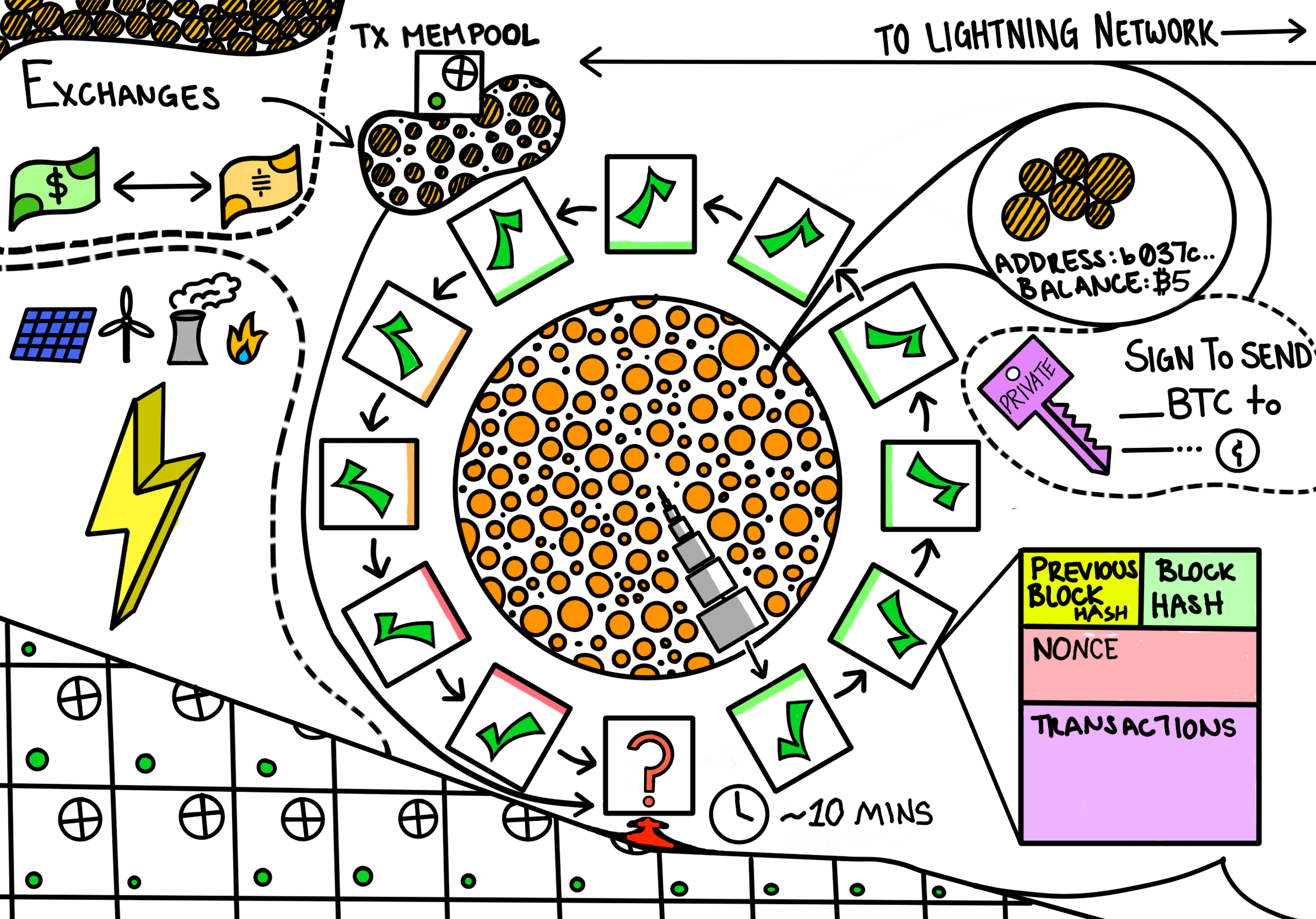
<p><img src="/assets/btc_system_diag.png" alt="Initial system diagram of Bitcoin. Going counterclockwise from the top left we have Exchanges. They take FIAT currency and trade it for cryptocurrency that they store on their own wallets. When withdrawing, they send the transaction to their nodes, and as a result - the mempool. Miners assemble the blocks, computing many hashes per second to secure the network. Every 10 minutes the next block is mined, confirmed, and added to the chain. These miners use energy to mine the current block. Next, we see the elements of a block and how they are linked together to form a blockchain. In the top right we can see someone's wallet. Their 'Bitcoin' is stored on the public ledger. Their 'wallet' is really a transaction signing device built leveraging public / private key pairs. These factors paint a complex, yet inherently secure settlement system." /></p>

<h2 id="the-computationally-rate-limited-mint">The Computationally Rate Limited Mint</h2>

<p>Bitcoins are inherently secure due to the mining process. Approximately every 10 minutes a new block is validated by a miner. This has been happening since its inception 14 years ago. Each block requires a massive amount of computing power (currently 270 Exahash per second, or 270,000,000,000,000,000,000 hashes<sup><strong>2</strong></sup> at the time of writing) to add it to the blockchain. All of these hashes per second contribute towards securing <em>your</em> Bitcoin and transactions on the blockchain.</p>

<p><strong>[2]</strong> Hashes are the <em>result</em> of a one-way function. You put a value into the function and it returns a hash <em>unique</em> to the input. Hashes are a method of checking the veracity of something. Here’s an example table, feel free to check the sha2 sum on <a href="https://cyberchef.org">Cyber Chef</a> with a size of 256 and 64 rounds (standard for sha256).</p>

<table>
  <thead>
    <tr>
      <th>Input</th>
      <th>SHA256 Hash</th>
    </tr>
  </thead>
  <tbody>
    <tr>
      <td>Apples</td>
      <td>007f1d79a45f16841559163c2b80f037f03b3c5a644764ae9559a2cbed78218d</td>
    </tr>
    <tr>
      <td>ApPLeS</td>
      <td>a00a00d7879be8f20103e6b6b71daedd4a238752e84d367709de40f2f6ba084b</td>
    </tr>
    <tr>
      <td>APPLES</td>
      <td>ec836c5b8554fb2f92cc8fb9a43bc5ec4471cf1afde135d6a40a3cbea7e9d370</td>
    </tr>
    <tr>
      <td>Apples, please</td>
      <td>5885e1cc75be47201820508ddd0d973feeabd3ab3f72fc6bcd6a0cfae5851d41</td>
    </tr>
  </tbody>
</table>

<p>No matter what input was provided:</p>
<ul>
  <li>The length of the hashes stays the same</li>
  <li>The hashes themselves differ significantly</li>
</ul>

<p>So, why does the network need so many hashes per second to mine each Bitcoin block? This comes down to the current difficulty target, which gets adjusted every two weeks on average. Bitcoin was designed to meet the 1 block per 10 minutes requirement, so the difficulty of mining scales according to the amount of processing power present. Miners are responsible for these tasks:</p>
<ul>
  <li>Adding transactions to a block</li>
  <li>Finding a valid hash of all the transactions and nonce (special number) that meets the current difficulty target
    <ul>
      <li>Read: guessing and checking combinations of values until they get it right</li>
    </ul>
  </li>
  <li>Broadcasting their hash to get confirmed by the rest of the network
    <ul>
      <li>Upon successful mining, they receive the block reward</li>
    </ul>
  </li>
  <li>Upon adding the block to the blockchain, they begin mining the next one</li>
</ul>

<h2 id="the-stone-spreadsheet-the-blockchain">The Stone Spreadsheet (The Blockchain)</h2>

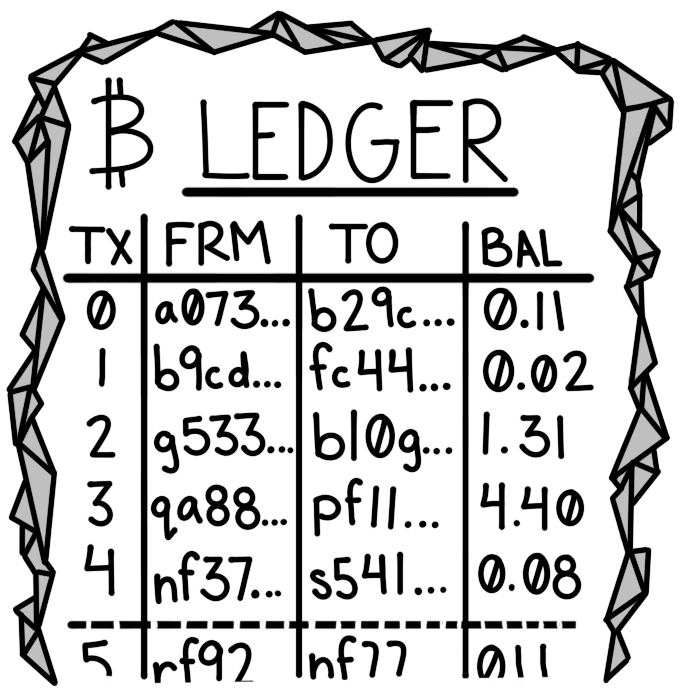
<p><img src="/assets/stone_ledger.png" alt="A spreadsheet set in stone. I.e. the Bitcoin public ledger" /></p>

<p>The blockchain is a globally distributed public ledger. It is possible to view every transaction that has happened in the history of Bitcoin on the blockchain. All parties are pseudonymous, sharing only their public keys with others and the world.</p>

<p>Let’s start with the ledger. In simplest terms, it is a record of payment between parties. It tracks where the payments went, where it came from, and the amount. In ‘blockchain’, blocks can be thought of as bundles of transactions - a continuation of the ledger from the previous block. What about those public keys?</p>

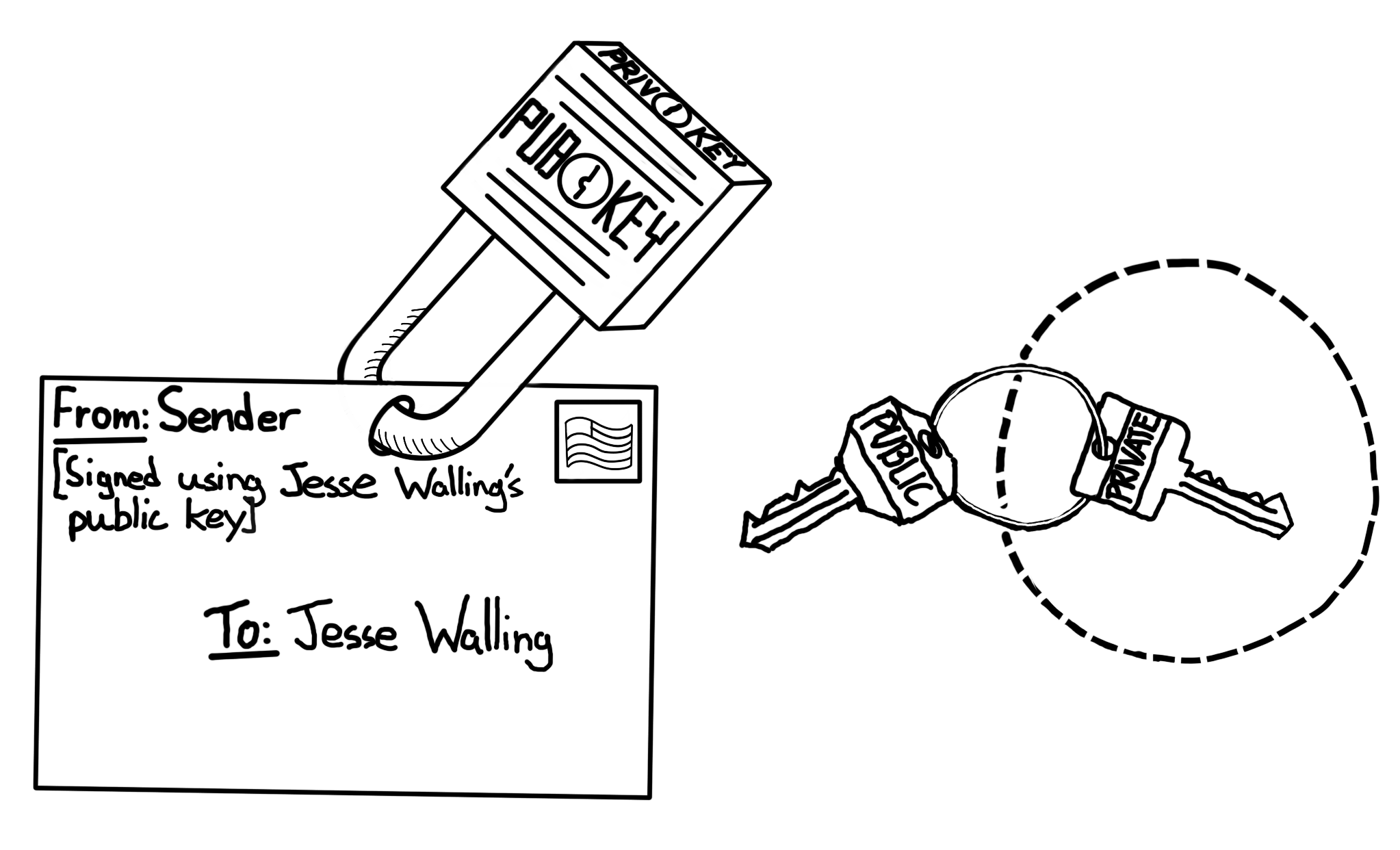
<p>Public / private key cryptography, also known as asymmetric cryptography, is primarily used to transmit messages or data securely between parties. When using public / private keys, the first step is to generate the key pair. For Bitcoin and other cryptocurrencies, this is automatically done when you create a wallet. The public key is linked cryptographically to the private key, but the keys themselves cannot be derived from each other. In order to send a secure message to someone else, you would need to encrypt the message with <em>their</em> public key. Once they receive the message, they can decrypt it with their own <em>private</em> key. This is exactly how Bitcoin is sent from one person to another. Your Bitcoin wallet address is the public key! Your private key should <strong>never</strong> be shared with anyone, period. Jot down those 12-24 words that represent it and secure them as best you possibly can.</p>

<p><img src="/assets/pub_priv.png" alt="Representation of public / private key cryptography, using a letter secured with a lock as an analogy" /></p>

<p>Now, how do blocks become the blockchain through mining? Let’s think about the blockchain with a simple analogy - a chain. In order for a chain to form, you need a beginning (the genesis block), the existing chain links, and the end (the most recently mined block). Mining a new block is just like adding a new link to the chain. It requires specialized machinery to complete (miners and Application Specific Integrated Circuits (ASICs)), relies on the prior links (previous blocks), and the robust material used to create it (the time and physical energy required to mine).</p>

<p>The new links are formed in the blockchain by continuing to leverage hashes. Each new block mined contains the hash of the previous block in its header. Therefore, in order to change the chain you would need to re-mine at least one block <em>and</em> the current block. This is shown in the bottom right corner of the Bitcoin system diagram from earlier.</p>

<h2 id="the-vault-self-custody">The Vault (Self Custody)</h2>

<p>With a 21 million Bitcoin supply limit, it represents digital property - but <strong>only</strong> when using a software or hardware wallet. When using a software (hot) or hardware (cold) wallet, this is considered self-custody. You are the custodian of your own assets rather than someone else. And that’s the crux of it - <em>your</em> Bitcoin. If holding cash is a guarantee that a bank has your money, self-custody is a guarantee that an exchange has your Bitcoin or cryptocurrency.</p>

<p><img src="/assets/wallet.png" alt="Highly secured wallet, comically drawn with a large safe-like lock" /></p>

<p>Self-custody achieves a few things:</p>
<ul>
  <li>Certifies ownership: It is impossible to hold paper Bitcoin (read: Bitcoin on exchanges / IOUs) through self-custody.</li>
  <li>Eliminates direct counterparty risk: The only way for your Bitcoin to be lost is if you lose your private key, period.
    <ul>
      <li>Note: There is indirect counterparty risk through market volatility - keep this in mind when considering your risk tolerance.</li>
    </ul>
  </li>
  <li>Enhances security: Utilizing your own piblic / private key pairs is an industry standard practice that secures the world wide web and countless open protocols.</li>
</ul>

<h2 id="the-value-utility">The Value (Utility)</h2>

<p>For these reasons, each Bitcoin (or even each Satoshi<sup><strong>3</strong></sup>), is a representation of both network ownership and a value capsule. These secured units of account currently have a relative value to the total supply as well as their USD (or other FIAT currency) value. I watch the BTC-USD charts to determine when we are in an accumulation range; not because I intend to sell at a higher price, but because I get more Sats (Satoshi) per dollar. Keep in mind, that Bitcoin - which continues to utilize mining, the blockchain, and public / private keys - can be sent anywhere in the world, at any time, with full settlement in less than half an hour.</p>

<p><strong>[3]</strong> Satoshis, also abbreviated as Sats are named after the creator of Bitcoin (Satoshi Nakamoto) and represent the smallest denomination possible. There are 100 million Satoshis per Bitcoin. An easy way to think about this is that 1% of a Bitcoin is 1 million Satoshis.</p>

<h2 id="theoretical-attacks-and-the-practical-shortcomings-of-them">Theoretical Attacks and the Practical Shortcomings of Them</h2>

<p>Why does mining provide security? In order for someone to revert or change the blockchain (read: our transactions) they would need to do 1 of 2 things:</p>
<ul>
  <li>Re-mine the blocks in question and all that follow it on their own</li>
  <li>Control over 51% of the total hashing power</li>
</ul>

<h3 id="block-rewriting">Block Rewriting</h3>

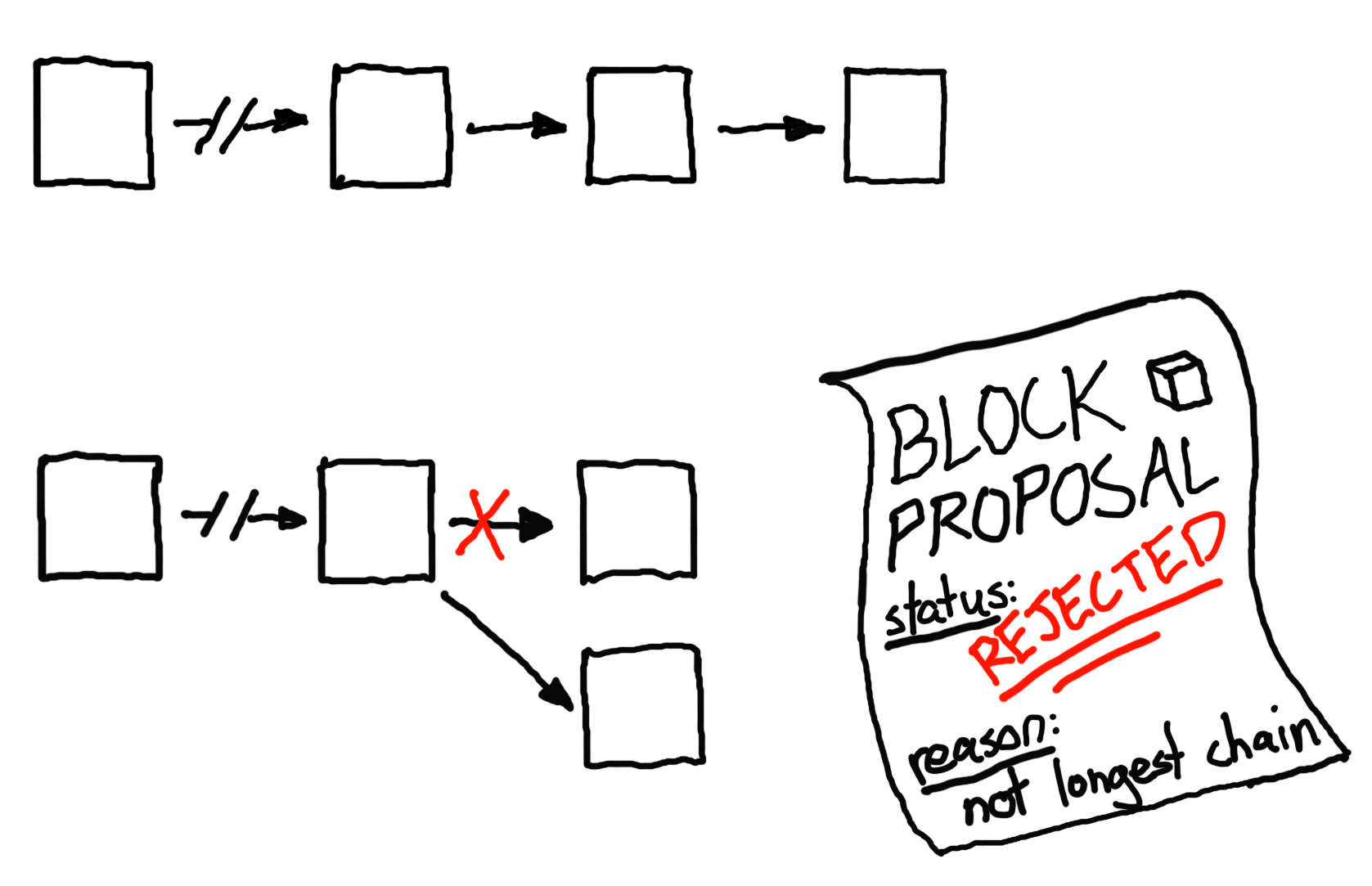
<p><img src="/assets/longest_chain.png" alt="Blockchain rewrite strategy. This is infeasible since the Bitcoin network only accepts the longest chain of blocks." /></p>

<p>OK, let’s look at the strategy of re-mining the specific block. If you successfully mined the block in question, that’s great and all, but you still need to mine the new blocks in the blockchain. <em>Just</em> mining the block in question wouldn’t make it valid. The official Bitcoin blockchain assumes that the longest chain provided is the valid one, since all nodes and miners confirmed that all the existing blocks are valid already. Changing the transaction inside of that block changes the hash of that block, and it wouldn’t be a valid Bitcoin blockchain until <strong>all</strong> the hash links form a valid chain, longer than the current one. This would require an adversary to complete, approximately (c*60*10)*n+1 hashes, where n is the number of blocks backwards and c is the current hashes per second. This is an infeasible number for any existing individual or supercomputer to achieve, even when n=3. Therefore, we can be very confident after at least 3 blocks that our transaction is, computationally, irreversible<sup>4</sup>.</p>

<p><strong>[4]</strong> That is, unless P=NP.</p>

<h3 id="majority-network-ownership">Majority Network Ownership</h3>

<p>Now, controlling 51% of the hashing power could be marginally easier. This is where one party or multiple cooperating parties have the majority of hashing power on the Bitcoin network. This would allow them to unequivocally create the longest chain, which would be assumed as truth by the Bitcoin protocol. Luckily, the scale of this operation would still be massive. If not massive, then counterintuitive to miners. As a competitive industry, each corporation seeks to have its own ‘edge’ over the others. The adversary would require more capial than many of the largest mining firms combined if operating alone. Not only that, but they would need the following:</p>
<ul>
  <li>Enough electricity to power the miners</li>
  <li>Cheap enough energy to stay afloat until 51% is achieved</li>
  <li>Physical storage space (i.e. large-scale datacenters) to hold the miners (ASICs)</li>
</ul>

<p>With all of these factors in view, Bitcoin is the perfect example of computational infeasibility from an adversarial perspective. Bitcoin makes the difficulty of attack so steep through computational asymmetries that attempting to do so is almost guaranteed to be futile.</p>

<h1 id="bitcoin-as-a-protocol">Bitcoin as a Protocol</h1>

<p>With open documentation, an active developer base, and open source software, Bitcoin also provides a foundational protocol to build on top of. One of the most prominent examples of this is the Lightning Network.</p>

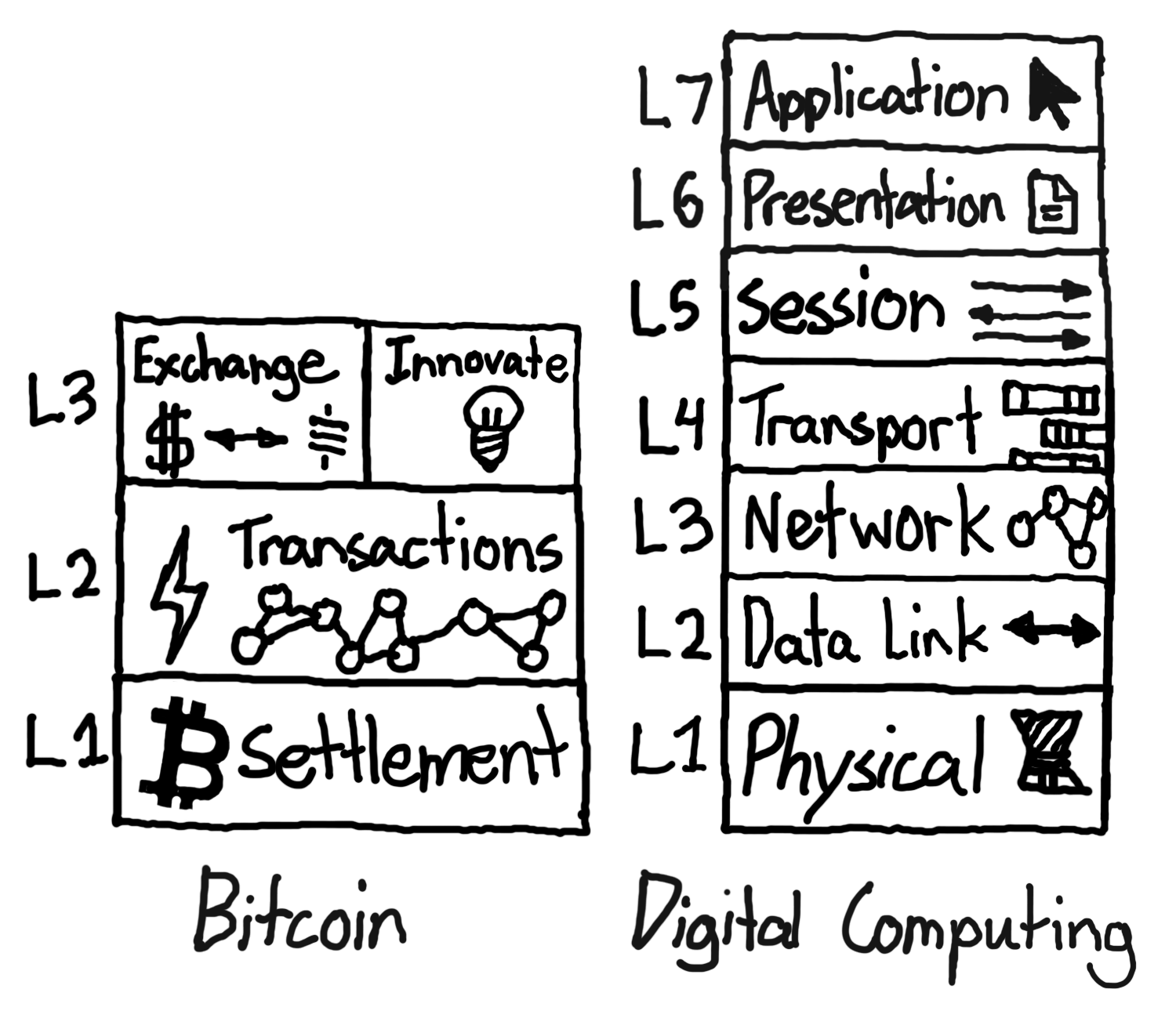
<p>Fees on the Bitcoin blockchain are relatively high, but do not scale relative to the transacation <em>amount</em>, but rather the transaction <em>size</em>. Therefore, the base blockchain of Bitcoin could be considered a settlement network that provides finality of transactions. The Lightning Network is considered a layer 2 protocol, since it is built on top of Bitcoin as the layer 1. The Lightning Network without Bitcoin would be almost useless. This follows a similar structure to the OSI model in computer systems and networks, where computing foundations and protocols build on top of each other to form a usable and powerful system.</p>

<p><img src="/assets/layers.png" alt="Diagram comparing layers of the Bitcoin stack with traditional digital computing" /></p>

<p>The Lightning Network utilizes channels to establish connections between users. These channels require a balance of Bitcoin to be present because a ledger is maintained, much like Bitcoin, but with unconfirmed transactions. Once the parties want to settle transactions, only one of them needs to provide the shared ledger to the Bitcoin network - the transactions are already recorded on the ledger, they just need to be officially settled. At a very high level, it can be thought of as a bar tab - record purchases and balances, run the check when closing or as requested.</p>

<p>I’m no expert on the Lightning Network, but I intend to learn more about it throughout 2023. One promising use case that has gotten a lot of buzz in the Bitcoin community has been Nostr, a social network built on top of the Lightning Network.</p>

<h1 id="bitcoin-as-a-speculation">Bitcoin as a Speculation</h1>

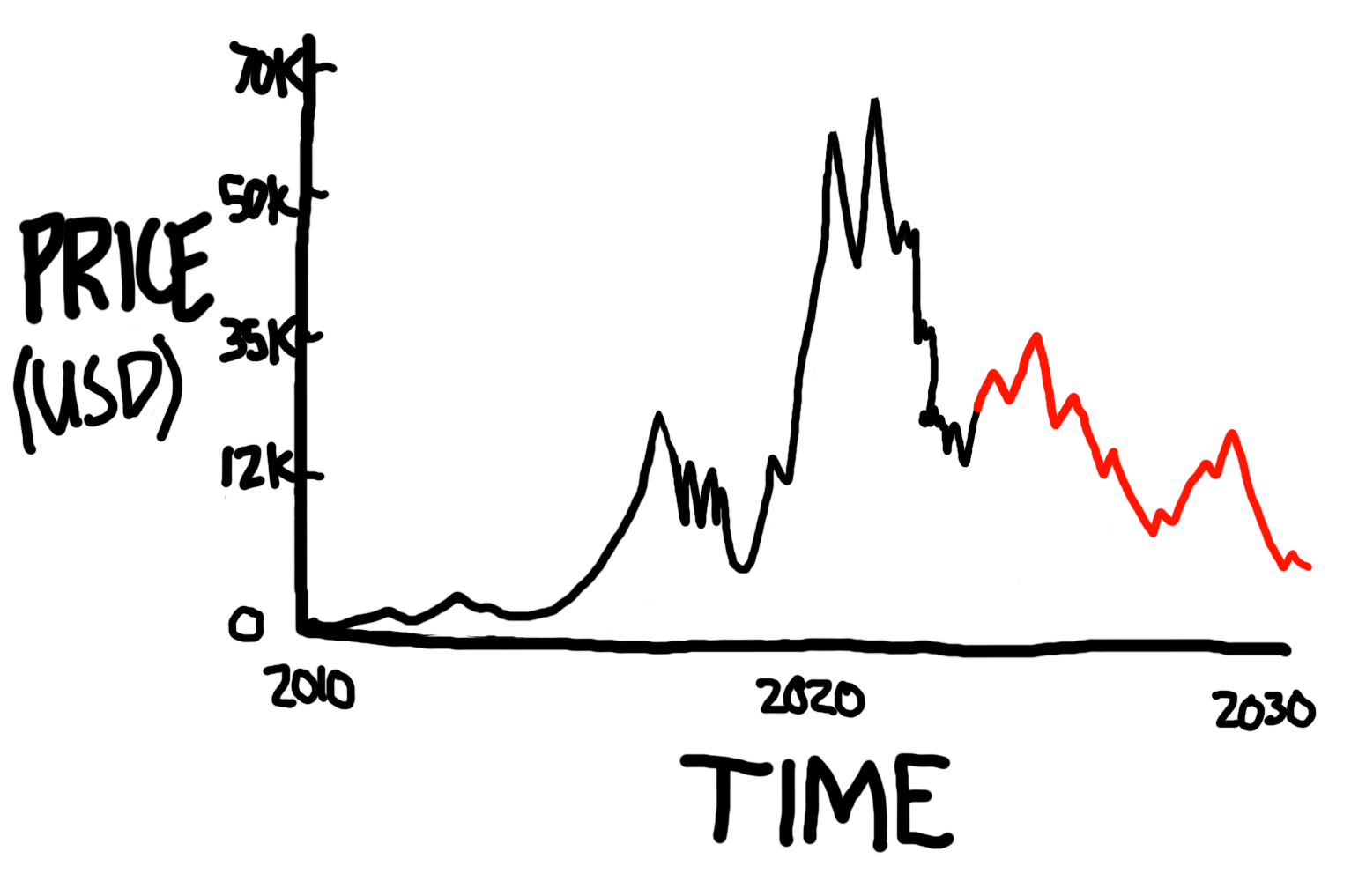
<p>As a commodity that can be traded on many different exchanges, the price of Bitcoin has been known to swing wildly both up and down. There are a number of cases for each direction looking to the future.</p>

<h2 id="the-bullish-future">The Bullish Future</h2>

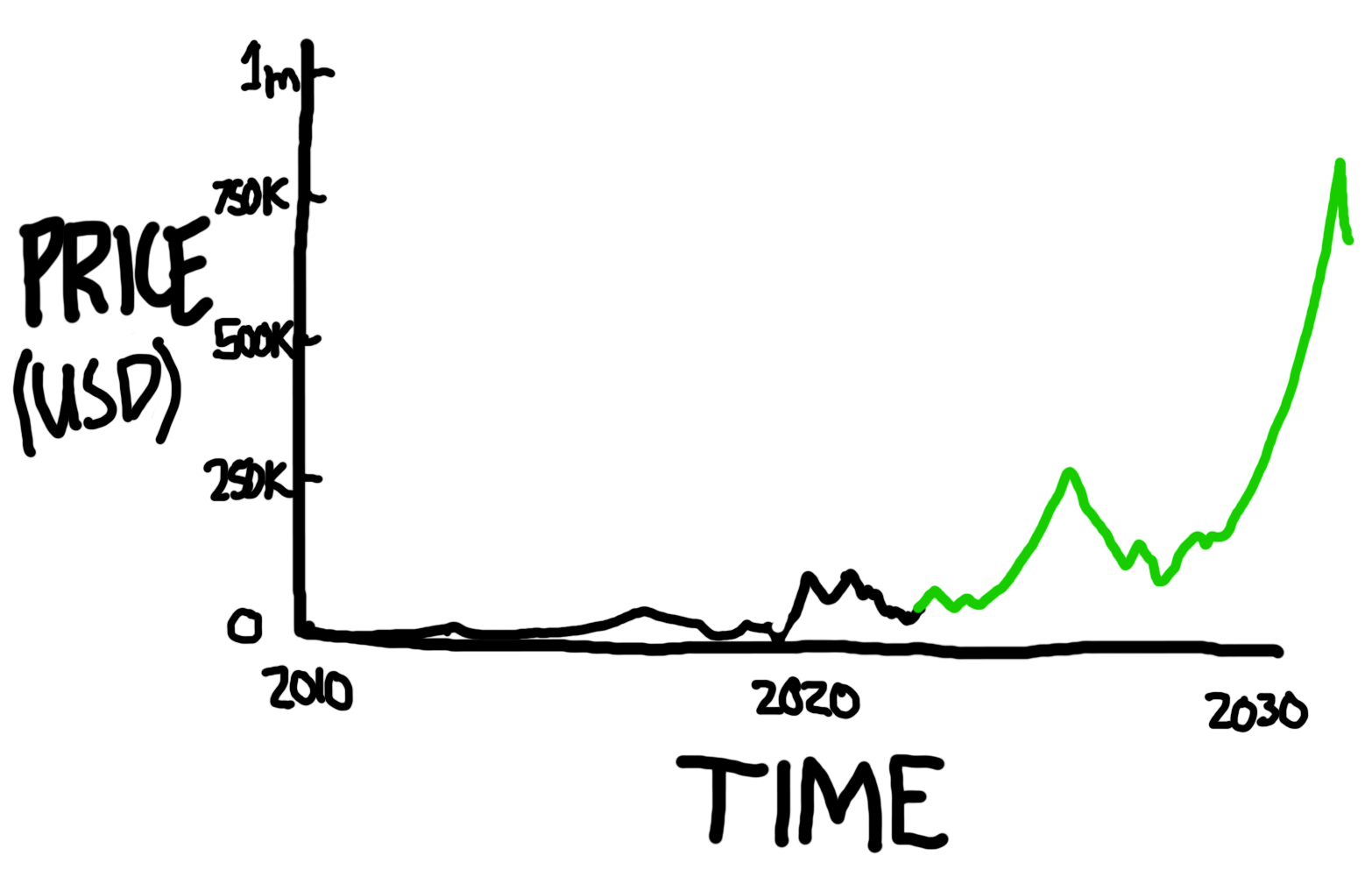
<p><img src="/assets/bullish.png" alt="A bullish price estimation, with Bitcoin reaching new all time highs by 2030." /></p>

<p>Over the years, Bitcoin has proven to be a resilient and powerful technology. The bullish future of Bitcoin is one where more people understand the value proposition and innovate around the already novel technology.</p>

<h3 id="sound-policy-in-an-unsound-world">Sound Policy in an Unsound World</h3>

<p>Bitcoin’s given properties lend it to be a sound monetary asset, similar to gold. Arguably, it is significantly easier to handle than gold. Instead of arranging for shipping of gold bars, you can send Bitcoin. Mining and scarcity are what make both Bitcoin and gold sound. With the U.S. Dollar, its fate is in the hands of the Federal Reserve and U.S. monetary policy. The cost to print is negligible compared to the value created out of thin air, which is unsustainable in the long term.</p>

<p>The future looks bleak for global markets in the near term. Central banks all around the world are rushing to tighten monetary policy after loosening it since the financial crisis of 2008. We have been living in a credit-driven society for too long and now the debt is catching up, <em>fast</em>. We see a recession on the horizon after U.S. Government Bond yield curve inversion<sup><strong>5</strong></sup>. We see layoffs picking up, especially in tech. We see the debt ceiling being reached and are on the precipice of a literal $1 trillion dollar coin mint. No, that is not a joke. These strategies and impacts of federal policy are far-reaching and collossal in scale.</p>

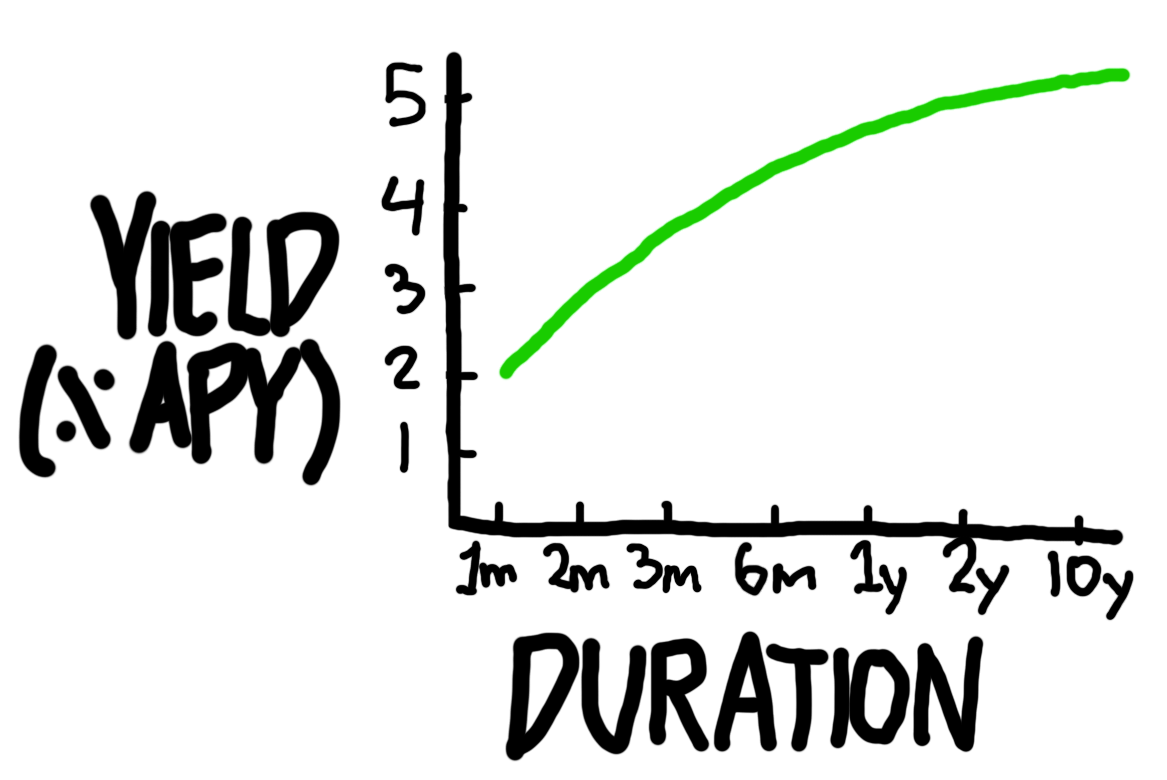
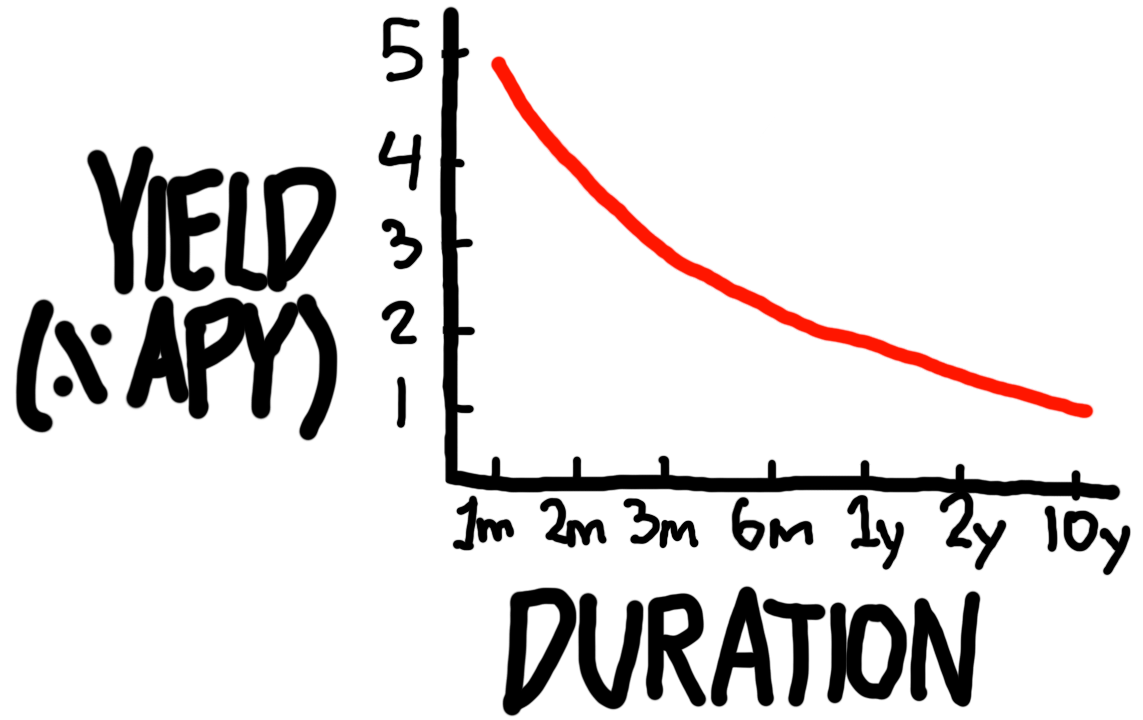
<p><strong>[5]</strong> Yield curve inversion is a financial anomaly, indicating lack of confidence in the market to meet interest rate quotas on government bonds. Typically, the yield curve looks healthy - increasing duration bonds have increasing yields.</p>

<p><img src="/assets/healthy_yc.png" alt="Illustration of a healthy yield curve, representing a logarithmic type trajectory as durations increase" /></p>

<p>This makes sense, right? If you lend the government your money for longer, you should get a higher return back.</p>

<p>Inverted yields, on the other hand, are where the return of a long term bond like the U.S. 10 year has a significantly lower return than shorter duration bonds like the 2 year or 3 month. It is typically a harbinger of an approaching recession.</p>

<p><img src="/assets/inverted_yc.png" alt="Illustration of an unhealthy yield curve, representing exponential decay as durations increase" /></p>

<p>It is possible to see Bitcoin as a breath of fresh air in such a chaotic environment. What does Bitcoin have that the U.S. monetary system doesn’t? Accountability. We can view the blockchain with truth and veracity, churning out a new block and ₿6.25 every 10 minutes, knowing that it represents debit instead of credit in the system.</p>

<h3 id="increasing-adoption-for-better-and-worse">Increasing Adoption (For Better and Worse)</h3>

<p>Millions of people use Bitcoin. If this technology is anything else like other revolutions in history, there could be billions of users in due time. Given the ability to send Bitcoin anywhere in the world, it is a global technology. With large institutions and even countries adopting Bitcoin, we could see not only an influx of individuals using the technology, but also nation states and large scale trade networks.</p>

<p>Recently, Saudi Arabia expressed interest in <a href="https://www.bloomberg.com/news/articles/2023-01-17/saudi-arabia-open-to-talks-on-trade-in-currencies-besides-dollar">pursuing oil deals in currencies other than the U.S. Dollar</a> [Bloomberg]. The ‘petrodollar’ has been in existence and exclusively used in oil trade since the 1970s. This could be the beginning of a tide shift for international trade. Why wouldn’t they allow for Bitcoin in the future? The fees are extremely low for large transfers of value between parties, with 24/7 settlement. There are no bounds to the trade that could be settled using Bitcoin in a highly globalized world. Unfortunately, we see worldwide trade forming around economic spheres of influence primarily due to the war in Ukraine. Bitcoin is a software project, not a political ideology.</p>

<h2 id="the-bearish-future">The Bearish Future</h2>

<p><img src="/assets/bearish.png" alt="A bearish price estimation, showing Bitcoin reaching new multi-decade lows by 2030." /></p>

<p>While Bitcoin has an attractive value proposition, there are hurdles that it needs to overcome in the future.</p>

<h3 id="inclusion-in-the-everything-bubble">Inclusion in ‘The Everything Bubble’</h3>

<p>When interest rates were low, borrowing money was easy - not just for individuals, but for startups, large corporations, local businesses, and the U.S. Government. We took this easy money for granted, letting the pile of low interest debt accumulate while monetary gains rocketed to new highs in the economy, equity markets, and cryptocurrency. If what we have seen in 2022 is the pop of a 14 year bubble, Bitcoin is between a rock and a hard place.</p>

<p>Up until now, Bitcoin hasn’t existed in a high interest rate environment. It is impossible to know its resiliency until the effects of interest rate increases are fully integrated into the economy. We may never see the full pop of this bubble if it causes the Federal Reserve to start lowering interest rates and turning towards Quantitative Easing (QE) again to stimulate the economy.</p>

<h3 id="decreasing-mining-rewards-the-halving">Decreasing Mining Rewards (The Halving)</h3>

<p>Every 4 years, the block reward for mining gets cut in half. Below, we can see the block reward schedule for Bitcoin over time.</p>

<table>
  <thead>
    <tr>
      <th>Year</th>
      <th>Block Reward, ₿</th>
    </tr>
  </thead>
  <tbody>
    <tr>
      <td>2009</td>
      <td>50</td>
    </tr>
    <tr>
      <td>2012</td>
      <td>25</td>
    </tr>
    <tr>
      <td>2016</td>
      <td>12.5</td>
    </tr>
    <tr>
      <td>2020</td>
      <td>6.25</td>
    </tr>
    <tr>
      <td>2024</td>
      <td>3.125</td>
    </tr>
    <tr>
      <td>2028</td>
      <td>1.5625</td>
    </tr>
    <tr>
      <td>2032</td>
      <td>0.78125</td>
    </tr>
    <tr>
      <td>2036</td>
      <td>0.390625</td>
    </tr>
  </tbody>
</table>

<p>As we can see, the block reward will fall below a whole Bitcoin in 2032. The question is, will that block reward be enough to motivate miners to secure the network? So far, this halving schedule has been bullish for the price and network security. Each halving is abrupt, decreasing the supply while maintaining or increasing demand. Naturally, the price of Bitcoin rises once supply decreases.</p>

<p>But what if the supply issuance <em>and</em> demand drops? Well, then mining is no longer an attractive industry. The operating costs would be too high for miners to continue, leaving only those who have negligible electricity costs. Currently, the success of Bitcoin relies on an increasing price to remain sustainable as a network. In my opinion, we will know whether or not this is a valid concern in either 2032 (once the block reward is less than ₿1) or 2036 to 2040 (once the block reward is comparable to the amount of fees per block). Network health of any sort past this point, either through low cost and renewable electricity or other means would be extremely bullish for Bitcoin leading into the second half of the 21st century.</p>

<p>What would this downfall look like? Well, there would be a series of cascading dominos:</p>
<ol>
  <li>Majority of miners stop mining 1-2 years after the halving
    <ol>
      <li>Lack of demand fails to ignite bull run</li>
    </ol>
  </li>
  <li>Hash rate decreases, without an immediate difficulty adjustment</li>
  <li>Blocks are mined significantly slower than they should be</li>
  <li>Bitcoin gets sold off on exchanges and self-custody users are left unable to sell their holdings for extended periods of time</li>
</ol>

<p>Now, that is the <strong>worst</strong> case example. An intermediate (and more likely) case would be that the hash rate slowly declines and the difficulty adjustment scales accordingly. This would result in a less damaging sell-off but would mark the demise of Bitcoin until all miners can utilize extremely low cost electricity or other catalysts.</p>

<h1 id="bitcoin-as-freedom">Bitcoin as Freedom</h1>

<p>When using Bitcoin, you declare that decisions around money are your own. You understand the risks, but you also understand Bitcoin. There is no functionality in the Bitcoin network that would freeze your assets or deny transactions, period. Contrast this with the current monetary system, where bank accounts can be frozen and transactions can be limited.</p>

<p>Bitcoin detaches itself from the siloed institutions of FIAT money. When you buy or earn Bitcoin, you take a stance against established financial institutions and outdated practices. Committing to buying Bitcoin is a reallocation of capital to a new world of money and governance. Your dollars aren’t really yours, but your Bitcoin really is.</p>

<h1 id="bitcoin-as-innovation">Bitcoin as Innovation</h1>

<p>Remember how we were talking about the mining death spiral in a bearish future for Bitcoin? If we can anticipate the failure points in advance and shift the industry now, we don’t need to worry about it.</p>

<p>Let’s think about it this way. Energy production at any given time must <em>at least</em> meet the demand of everyone currently using it. Individuals pay for what they use and the energy providers continue operation with their profits. Many miners are consumers of energy too - they pay for the electricity they use to mine, which must be factored into their margins from block rewards. What if they didn’t need to do that at all? There are a number of Bitcoin mining operations that utilize <strong>excess</strong> supplies of energy. Without Bitcoin mining, that energy just wouldn’t be utilized. Instead of paying to use it, miners can use the excess for free and provide a cut of the block rewards to the energy producers.</p>

<p>Personally, I hope to see continued advancement of mining where energy supply exceeds demand through wind, solar, geothermal, and nuclear power through the rest of the 2020s. A recent podcast episode of <em>What Bitcoin Did</em> talked with a small mining company in Africa facilitating mutually beneficial agreements with micro grid energy providers: <a href="https://youtu.be/h2mvzUd9GMo">YouTube</a>.</p>

<h1 id="ethereum-as-competition">Ethereum as Competition</h1>

<p>Ethereum is a different cryptocurrency that was created in 2014 by Vitalik Buterin. While it still utilizes a blockchain, the specific mechanics are drastically different. For starters, it isn’t sound money. With Ethereum, there isn’t a supply limit. The total supply of Ethereum increases or decreases depending on how active the network is as a whole. Additionally, it uses Proof of Stake (PoS) rather than Proof of Work (PoW; mining), which encourages easy money much like the printing of U.S. Dollars.</p>

<p>One thing that Ethereum has going for it is the usage of smart contracts. The Ethereum blockchain was designed so that it could be developed on top of, behaving as a distributed computer. There are very few cryptocurrencies that resemble Bitcoin, but many that resemble Ethereum - competition is very high within the PoS smart contract project category.</p>

<p>While transactions are fast and developer involvement is high in Ethereum, I have a number of concerns:</p>
<ul>
  <li>Ambitious development goals
    <ul>
      <li>Provides an increased attack surface for adversaries</li>
    </ul>
  </li>
  <li>Not fully censorship resistant (fund freezing / U.S. software sanctions enforcement / denied transactions / special capabilities given to validators)</li>
  <li>Steep requirements to participate in the network as a validator (32 ETH minimum, over $40,000 at the time of writing)
    <ul>
      <li>The cost of running your own Bitcoin node should be less than a few hundred dollars each year</li>
    </ul>
  </li>
  <li>Developer disagreements
    <ul>
      <li>Recenly, developers have been debating whether or not to allow validators to withdraw their staked Ether in the next upgrade</li>
      <li>Allowing withdrawals during this upgrade has always been the plan, but they are not all on the same page of how to proceed; What happens when more complicated decisions need to be made?</li>
    </ul>
  </li>
  <li>Presence of a de-facto CEO: Vitalik Buterin</li>
  <li>Risk of being considered a security by the SEC (U.S. Securities and Exchange Commission)</li>
</ul>

<h1 id="crypto-as-an-immature-space">Crypto as an Immature Space</h1>

<p>Bitcoin has carried the torch for 14 years and doesn’t look like it will be giving it up anytime soon. Through the onslaught of alternative projects using Bitcoin as a jumping off point, many projects from previous market cycles have already faded into obscurity. The projects that stick around and never seem to go away - namely Bitcoin and Ethereum - show the value that they provide to the world by existing for the amount of time they have existed.</p>

<p>Many projects are dubbed ‘Ethereum Killers’, promising increased efficiency of the blockchain and lower transaction fees. If or when Ethereum kills Bitcoin, ‘Ethereum Killers’ still have a long way to go.</p>

<p>There are others considered ‘Meme Coins’ - the likes of DOGE (Doge Coin) and SHIB (Shiba Inu). These cryptocurrencies are purely hype driven with a lack of utility and use cases.</p>

<p>Who knows which cryptocurrencies will still be around in 10, 20, 50 years, but it doesn’t always pay off to bet on the underdog in financial markets. 14 years is a short period of time, and the air of permancence around Bitcoin and Ethereum with statements like ‘Bitcoin, not crypto’ is exclusionary and unrealistic. Bitcoin keeps it simple, and its simplicity is a major benefit. At the same time, who are we to say whether or not it will be around to carry the torch for eternity?</p>

<h1 id="conclusion">Conclusion</h1>

<p>In summary, Bitcoin exists. It chugs along every minute of every day, working to make the network the best place it can be to store value. It works tirelessly to provide clarity and security in a centralized and ingenuine world. Other cryptocurrencies exist, but their fate is in the hands of the SEC and whoever leads their development. Bitcoin might be one of the only commodities in the cryptocurrency space, and that speaks measures to its 14 year throne. It dares other projects and protocols to achieve what it has, forging ahead with simplicity and grace.</p>

<h1 id="acknowledgements">Acknowledgements</h1>

<p>Written and sketched by Jesse Walling with help from:</p>
<ul>
  <li>SethRogensLeftNut (Editing, Sketching)</li>
  <li>ChatGPT for the following:
    <ul>
      <li>Word choice for 1 section heading</li>
      <li>Clarifications on details of Bitcoin’s inner mechanics</li>
    </ul>
  </li>
</ul>]]></content><author><name></name></author><category term="Bitcoin" /><category term="Bitcoin" /><summary type="html"><![CDATA[]]></summary></entry><entry><title type="html">Welcome to Jesse’s Window!</title><link href="https://blog.jpwalling.com/jesses%20window/2022/12/30/welcome-to-jesses-window.html" rel="alternate" type="text/html" title="Welcome to Jesse’s Window!" /><published>2022-12-30T00:00:00+00:00</published><updated>2022-12-30T00:00:00+00:00</updated><id>https://blog.jpwalling.com/jesses%20window/2022/12/30/welcome-to-jesses-window</id><content type="html" xml:base="https://blog.jpwalling.com/jesses%20window/2022/12/30/welcome-to-jesses-window.html"><![CDATA[<p>Hello world! This is the very first blog post on Jesse’s Window, by myself - Jesse Walling.</p>

<p>I look forward to using this website as a showcase to what I am thinking about, current projects, future projects, and general discussions.</p>

<p>To start, there are a few plans I have for 2023:</p>
<ul>
  <li>Upgrade my personal site at <a href="https://jessewalling.com">https://jessewalling.com</a></li>
  <li>Add Nextcloud and other services to Blockbuster (previously GG Net)</li>
  <li>Run previous projects on Blockbuster (JOPENTS, SlimDiscogs, ImgLot, etc.)</li>
  <li>Provide insight into economic markets and cryptocurrencies</li>
  <li>Continue implementing and documenting best practice for network security on Blockbuster</li>
  <li>Document changes and current projects on Blockbuster</li>
</ul>

<p>There will be a wide array of topics discussed on Jesse’s Window, so hopefully something here is your cup of tea. Thank you for reading!</p>]]></content><author><name></name></author><category term="Jesses Window" /><category term="Getting Started" /><summary type="html"><![CDATA[Hello world! This is the very first blog post on Jesse’s Window, by myself - Jesse Walling.]]></summary></entry></feed>